Volume 7
Key papers
- — Rosicrucians and Freemasonry (Westcott)
- — Chinese Secret Societies — Triads
- — Sikh Initiation Rites
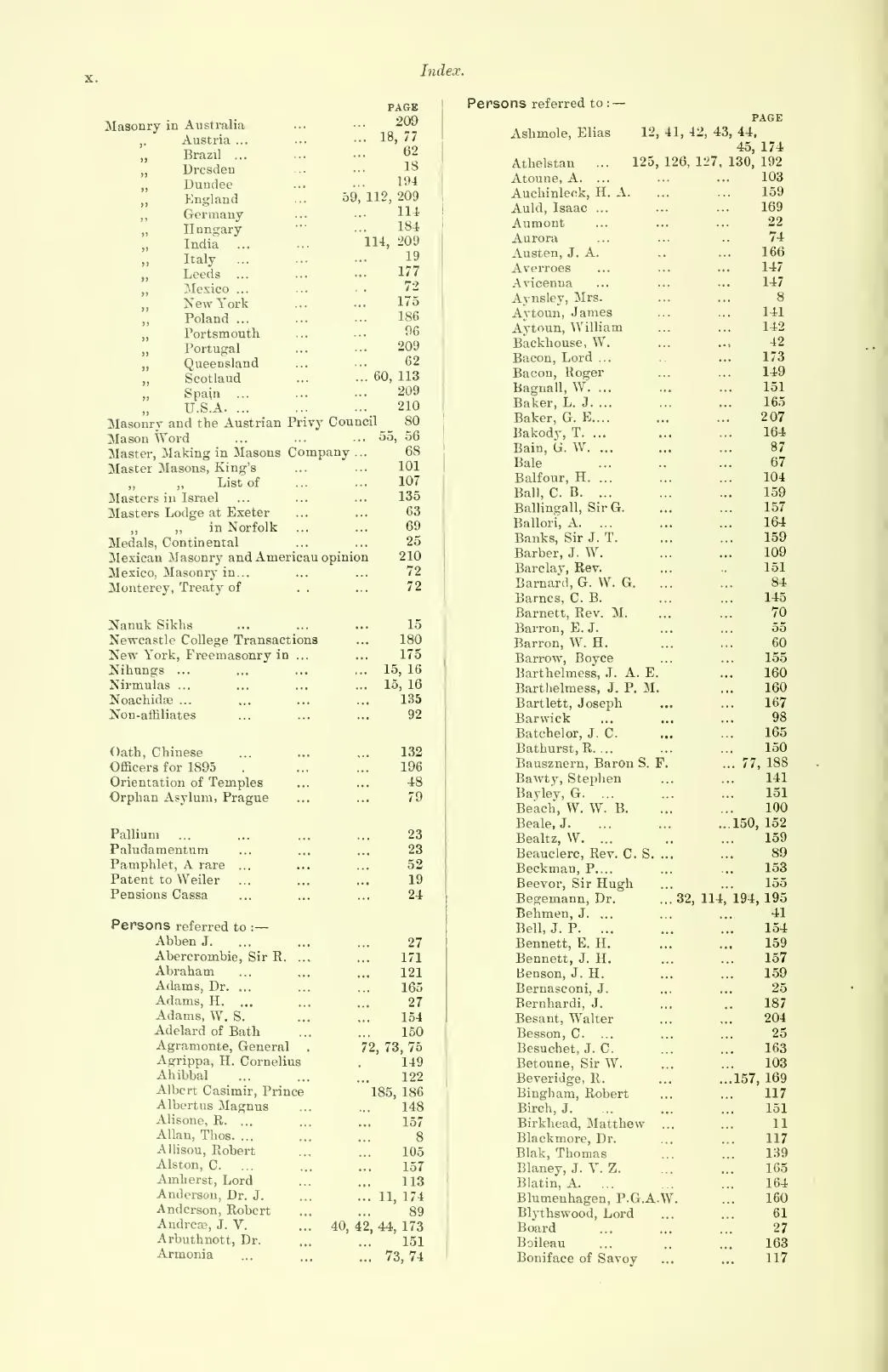
[Page 16] — Index (continued) — x.
[Index entries, continued from previous page. Two-column layout covering subjects from "Masonry in Australia" through "Monterey, Treaty of" and persons "Ashmole, Elias" through "Boniface of Savoy"]
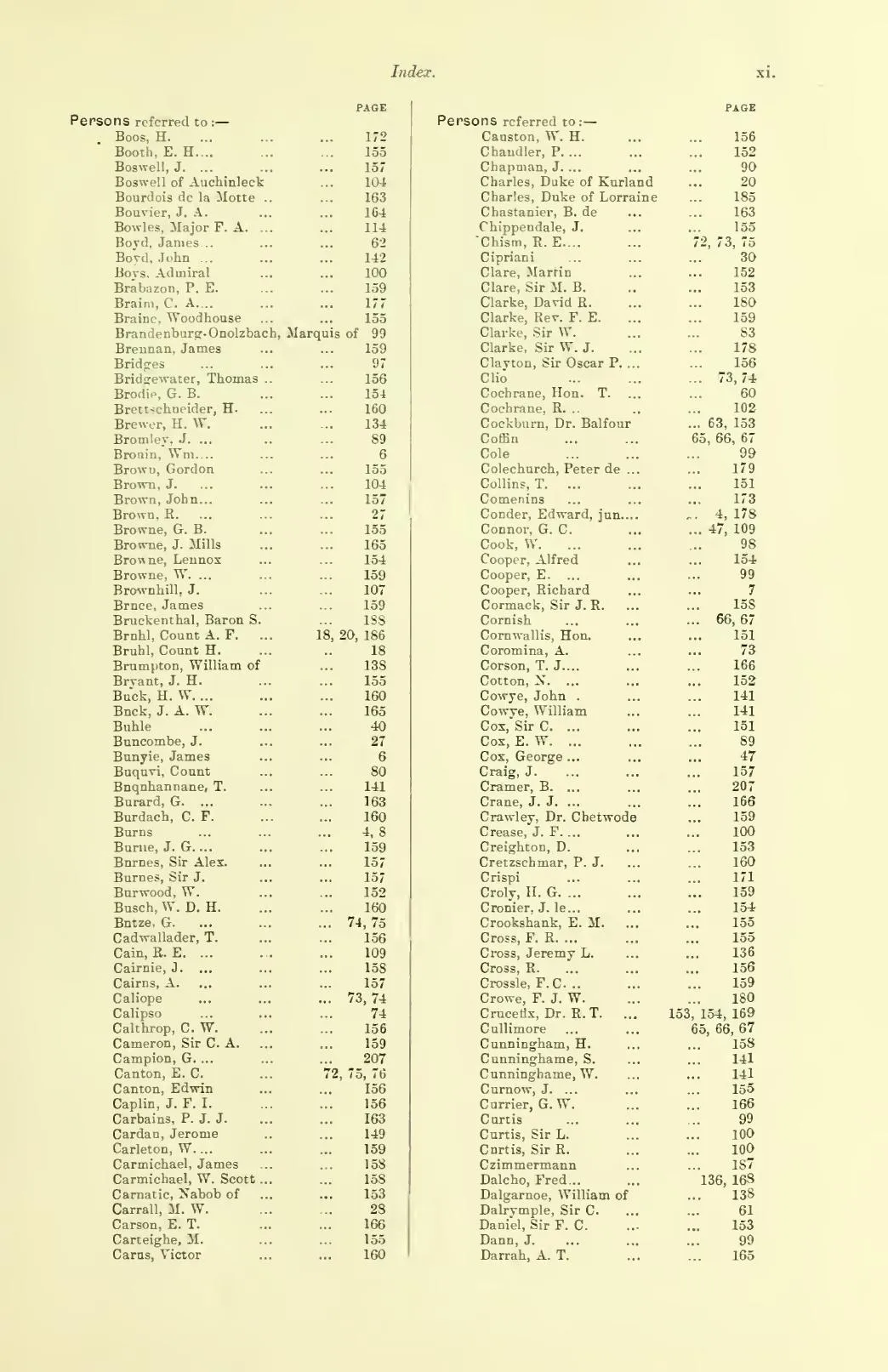
[Page 17] — Index (continued) — xi.
[Index entries continued. Persons: "Boos, H." through "Darrah, A. T."]
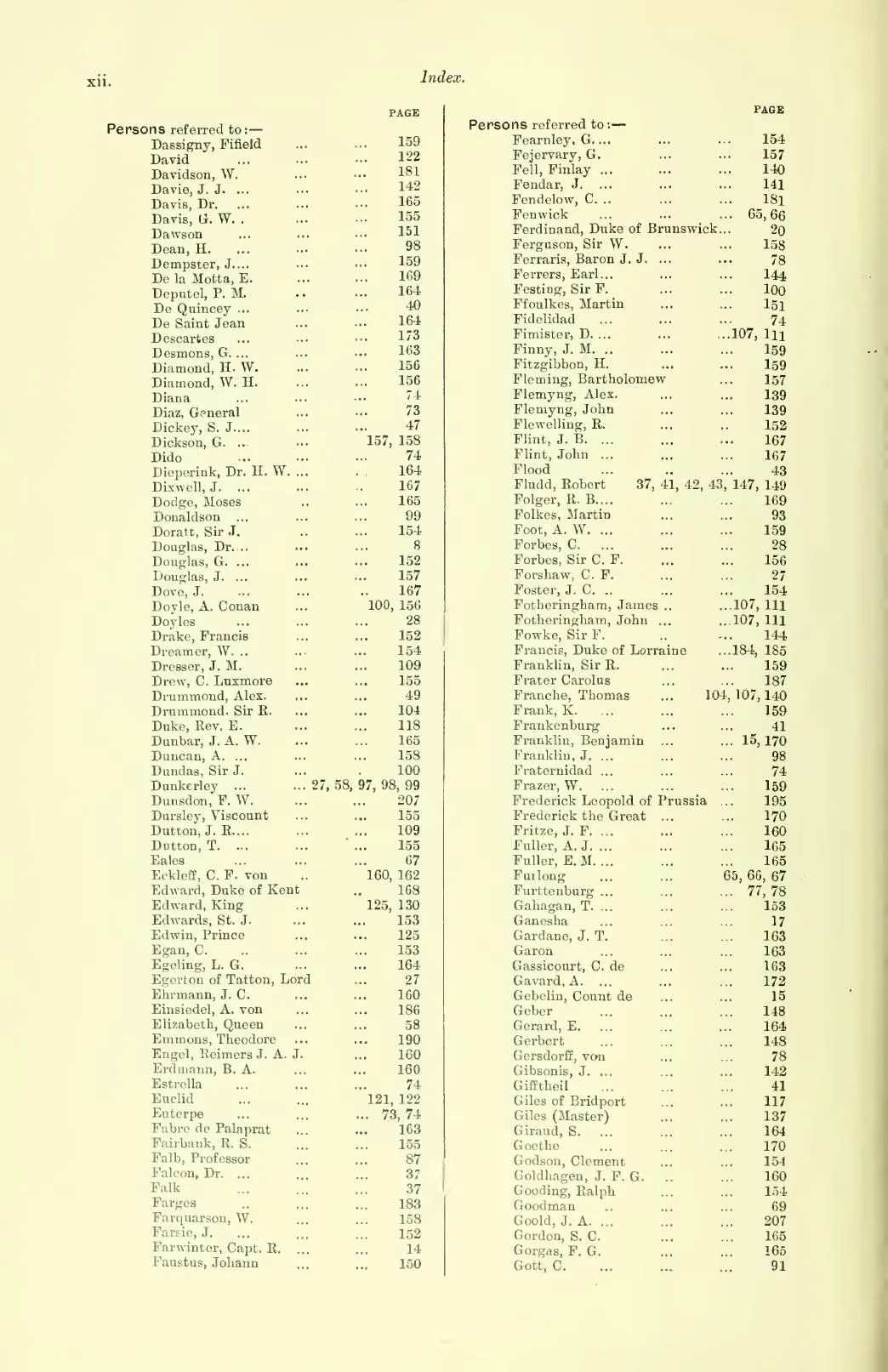
[Page 18] — Index (continued) — xii.
[Index entries continued. Persons: "Dassieny, Fifield" through "Gott, C."]
[Page 19] — Index (continued) — xiii.
[Index entries continued. Persons: "Gotter, Count von" through "Kempel, J. von"]
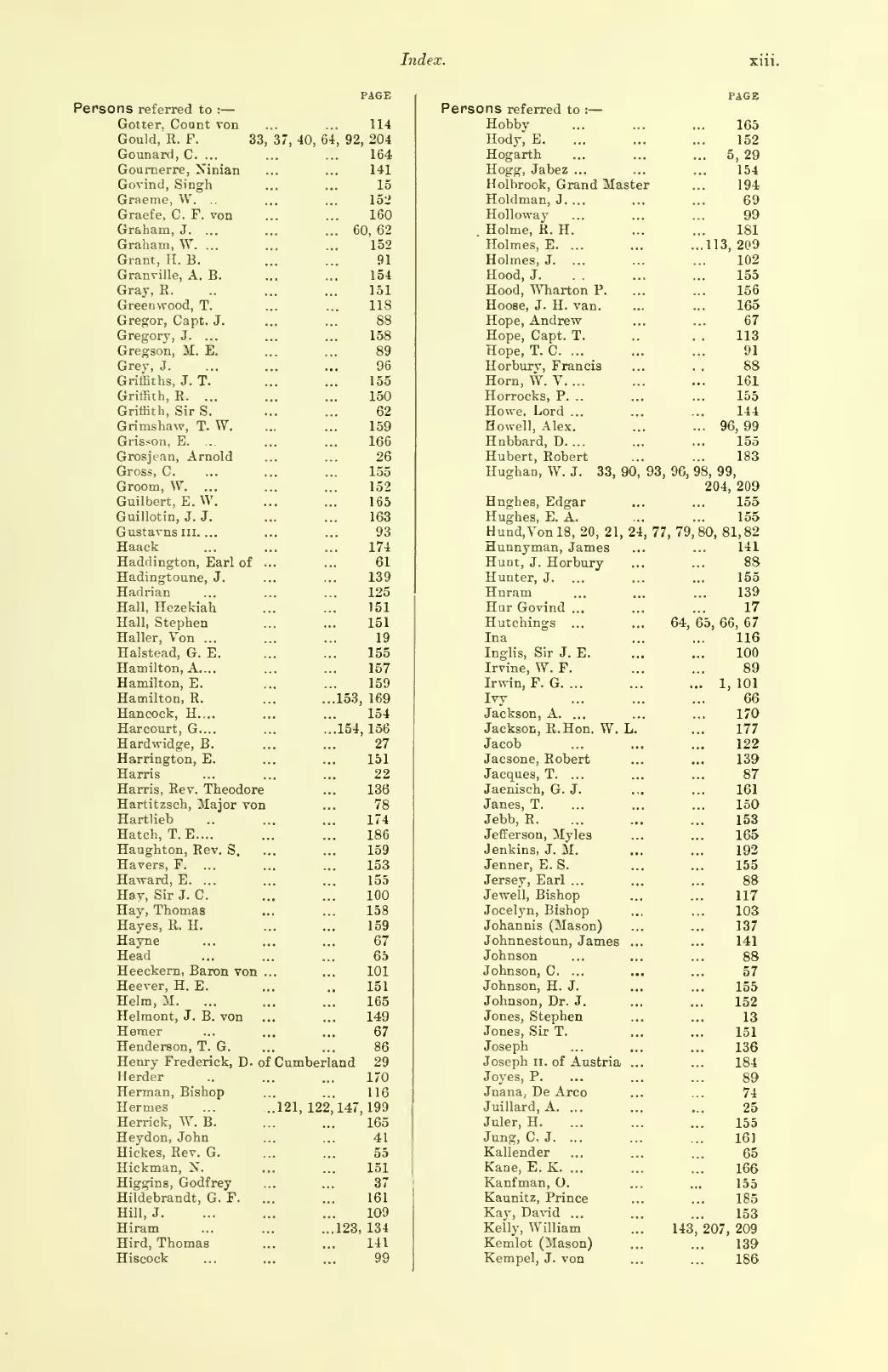
[Page 20] — Index (continued) — xiv.
[Index entries continued. Persons: "Kenning, G." through "Moncrief, J."]
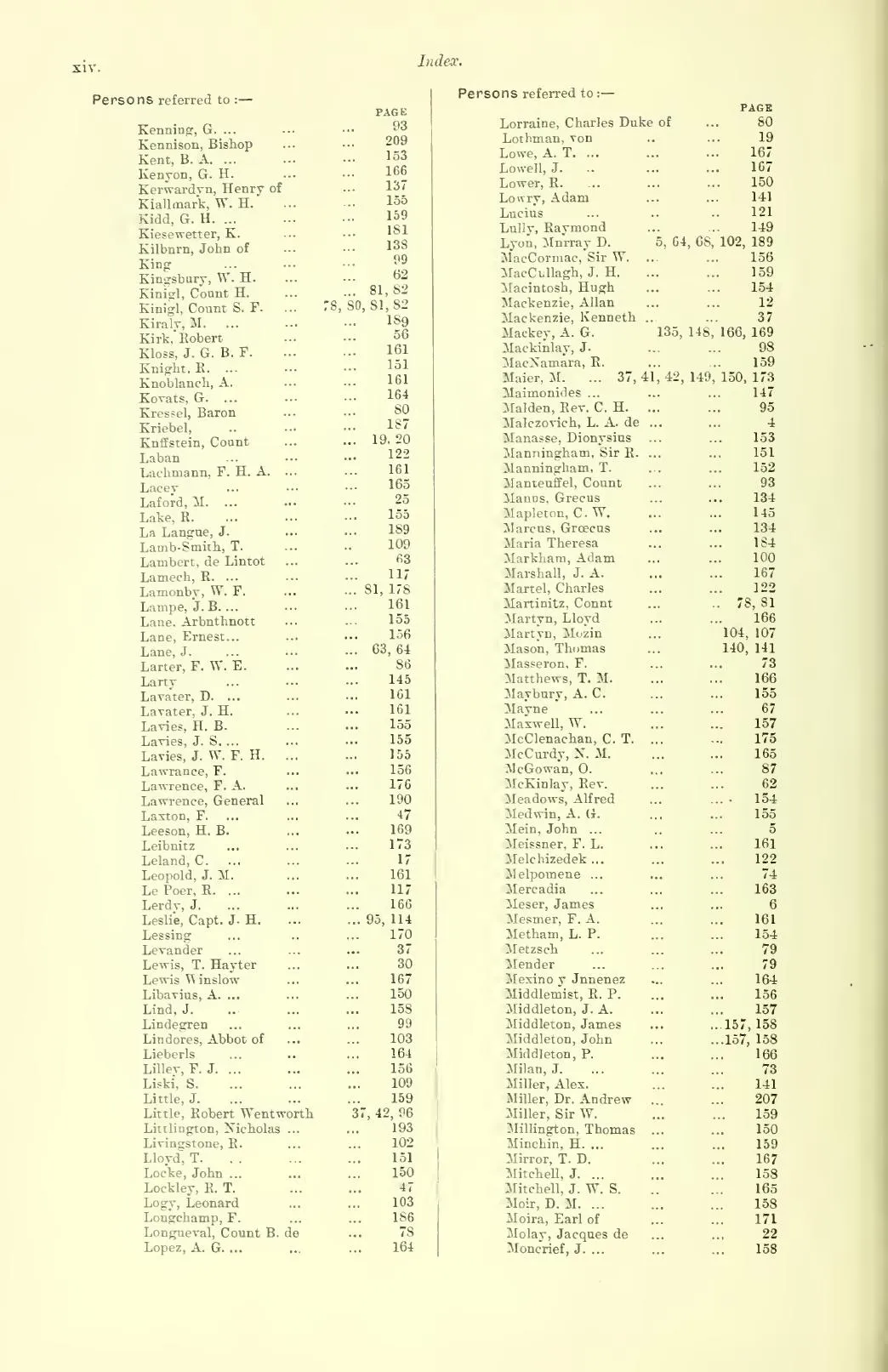
[Page 21] — Index (continued) — xv.
[Index entries continued. Persons: "Moore, P. Gomez" through "Reade, J. B. C."]
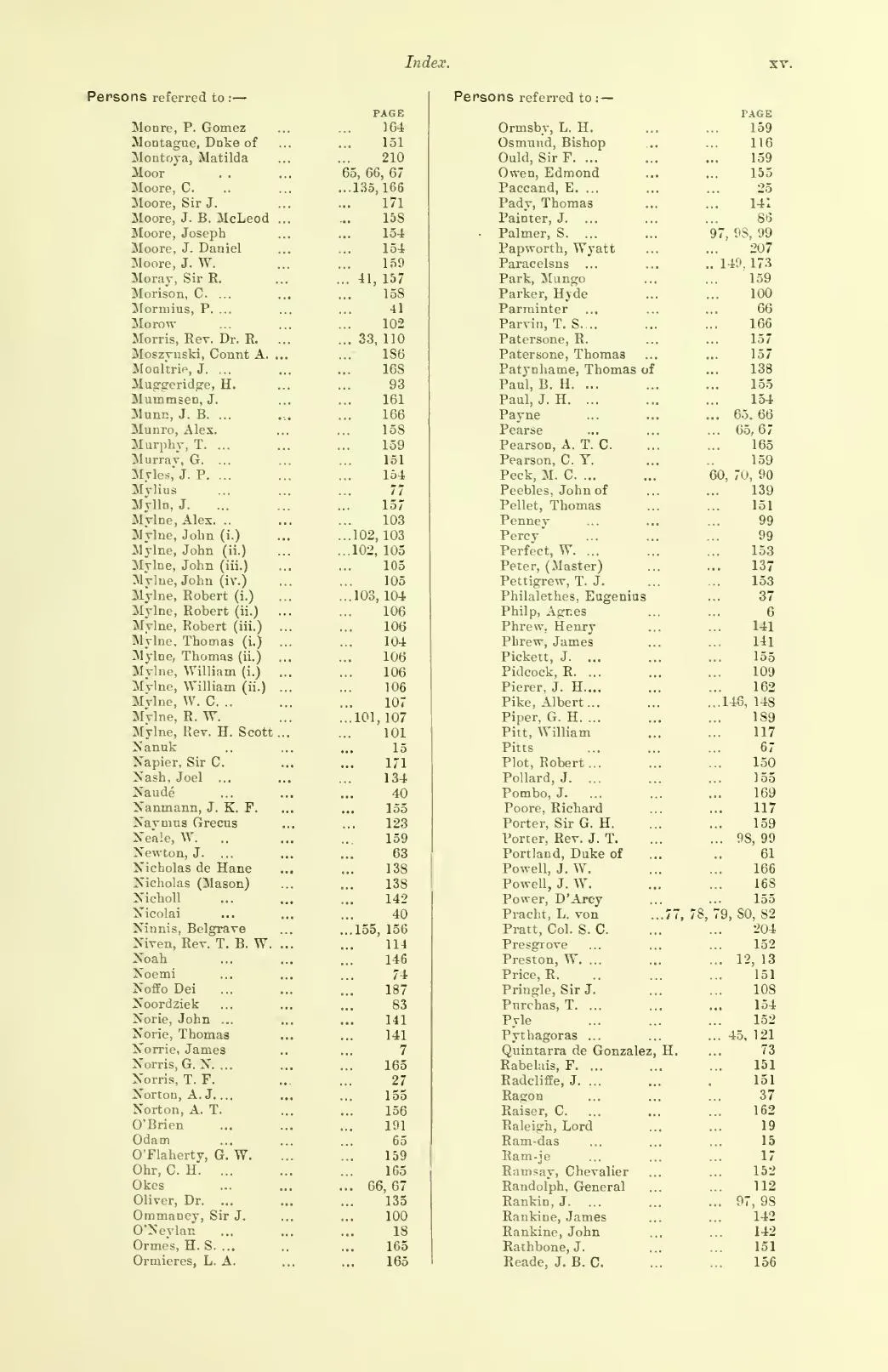
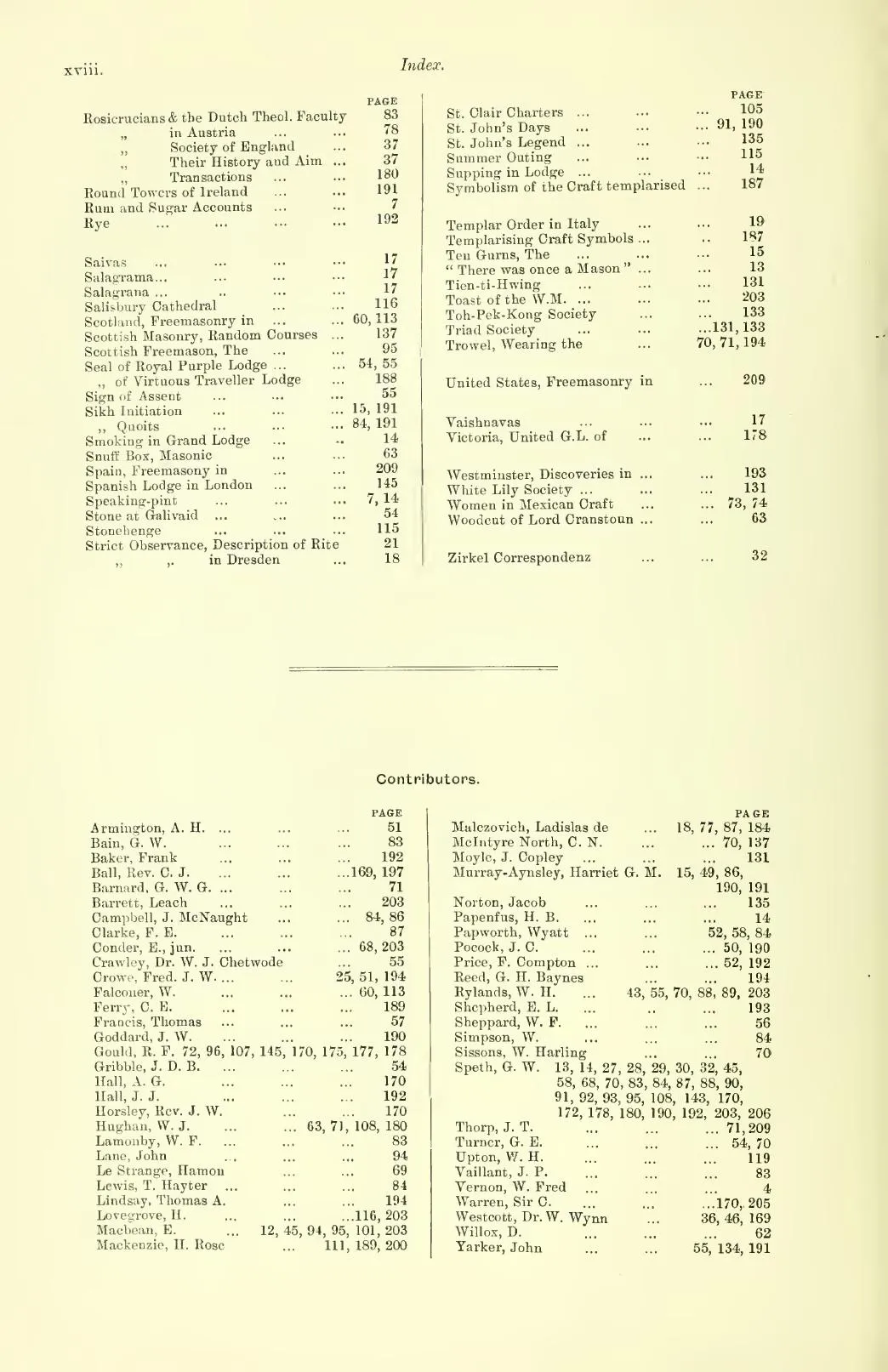
[Page 22] — Index (continued) — xvi–xviii.
[Final index pages. Subjects: "Rosicrucians & the Dutch Theol. Faculty" through "Zirkel Correspondenz." Followed by Contributors list with page references and List of Illustrations.]
Contributors (selected):
| Contributor | Pages |
|---|---|
| Gould, R. F. | 72, 96, 107, 145, 170, 175, 177, 178 |
| Hughan, W. J. | 63, 71, 108, 180 |
| Malczovich, Ladislas de | 18, 77, 87, 184 |
| McIntyre North, C. N. | 70, 137 |
| Moyle, J. Copley | 131 |
| Murray-Aynsley, Harriet G. M. | 15, 49, 86, 190, 191 |
| Norton, Jacob | 135 |
| Rylands, W. H. | 43, 55, 70, 88, 89, 203 |
| Speth, G. W. | 13, 14, 27, 28, 29, 30, 32, 45, 58, 68, 70, 83, 84, 87, 88, 90, 91, 92, 93, 95, 108, 143, 170, 172, 178, 180, 190, 192, 203, 206 |
| Upton, W. H. | 119 |
| Westcott, Dr. W. Wynn | 36, 46, 169 |
| Yarker, John | 55, 134, 191 |
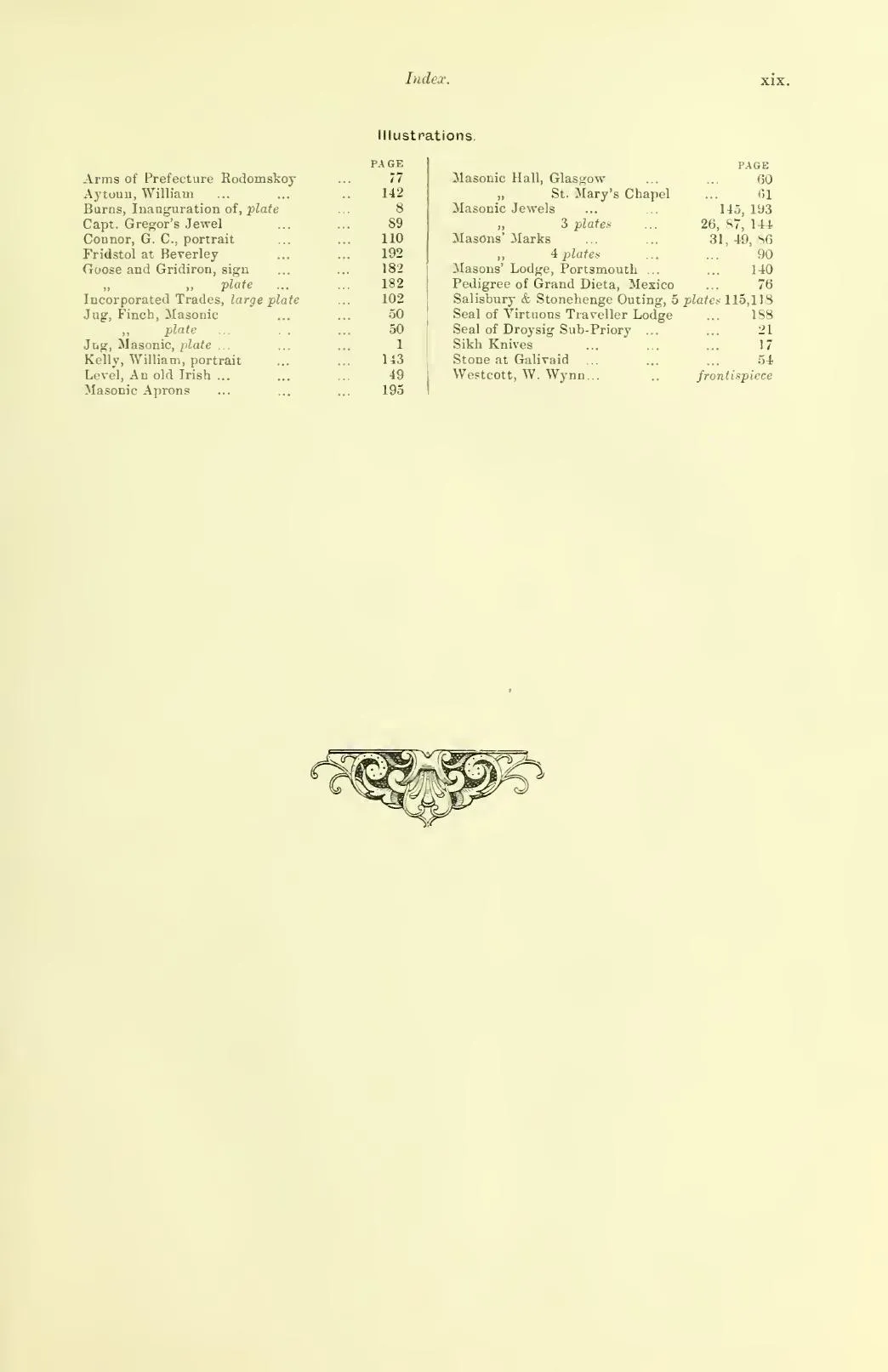
Illustrations:
| Subject | Page |
|---|---|
| Arms of Prefecture Rodomskoy | 77 |
| Aytoun, William | 142 |
| Burns, Inauguration of, plate | 8 |
| Capt. Gregor's Jewel | 89 |
| Connor, G. C., portrait | 110 |
| Fridstol at Beverley | 192 |
| Goose and Gridiron, sign | 182 |
| " " plate | 182 |
| Incorporated Trades, large plate | 102 |
| Jug, Finch, Masonic | 50 |
| " plate | 50 |
| Jug, Masonic, plate | 1 |
| Kelly, William, portrait | 143 |
| Level, An old Irish | 49 |
| Masonic Aprons | 195 |
| Masonic Hall, Glasgow | 60 |
| " St. Mary's Chapel | 61 |
| Masonic Jewels | 145, 193 |
| " 3 plates | 26, 87, 144 |
| Masons' Marks | 31, 49, 86 |
| " 4 plates | 90 |
| Masons' Lodge, Portsmouth | 140 |
| Pedigree of Grand Dieta, Mexico | 76 |
| Salisbury & Stonehenge Outing, 5 plates | 115, 118 |
| Seal of Virtuous Traveller Lodge | 188 |
| Seal of Droysig Sub-Priory | 21 |
| Sikh Knives | 17 |
| Stone at Galivaid | 54 |
| Westcott, W. Wynn | frontispiece |
[Page 23] *Blank page*
[Page 24] *Blank page*

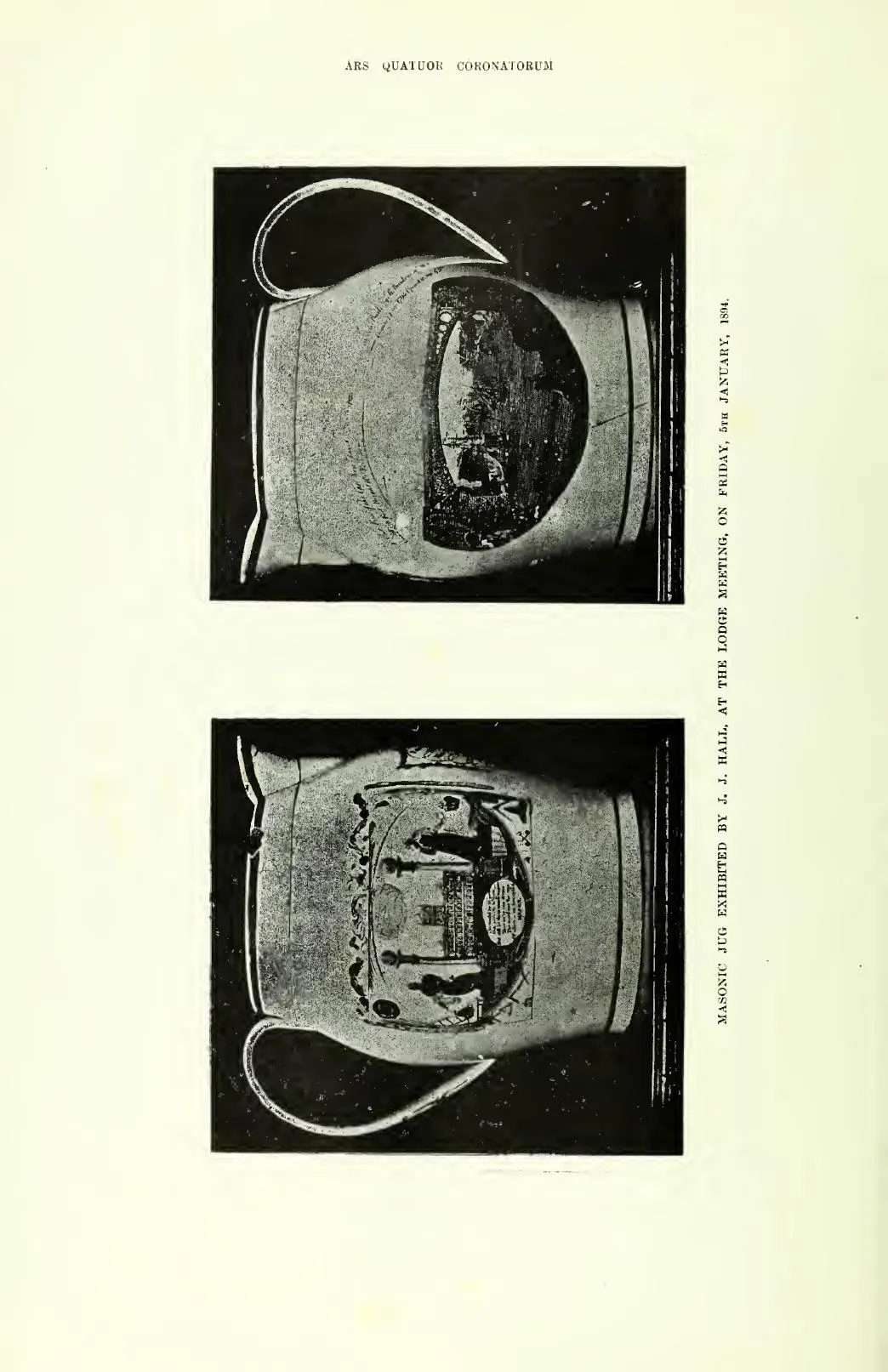
[Page 25] *Plate — Masonic Jug*
ARS QUATUOR CORONATORUM.
[Illustration: Two photographs of a Masonic Jug exhibited by J. J. Hall, at the Lodge Meeting, on Friday, 5th January, 1894. The jug is decorated with Masonic imagery and landscape scenes.]

[Page 26] — Lodge Proceedings — 1
Ars Quatuor Coronatorum,
BEING THE TRANSACTIONS OF THE
Lodge Quatuor Coronati of A.F. & A.M., London.
No. 2076.
VOLUME VII.
FRIDAY, 5th JANUARY, 1894.
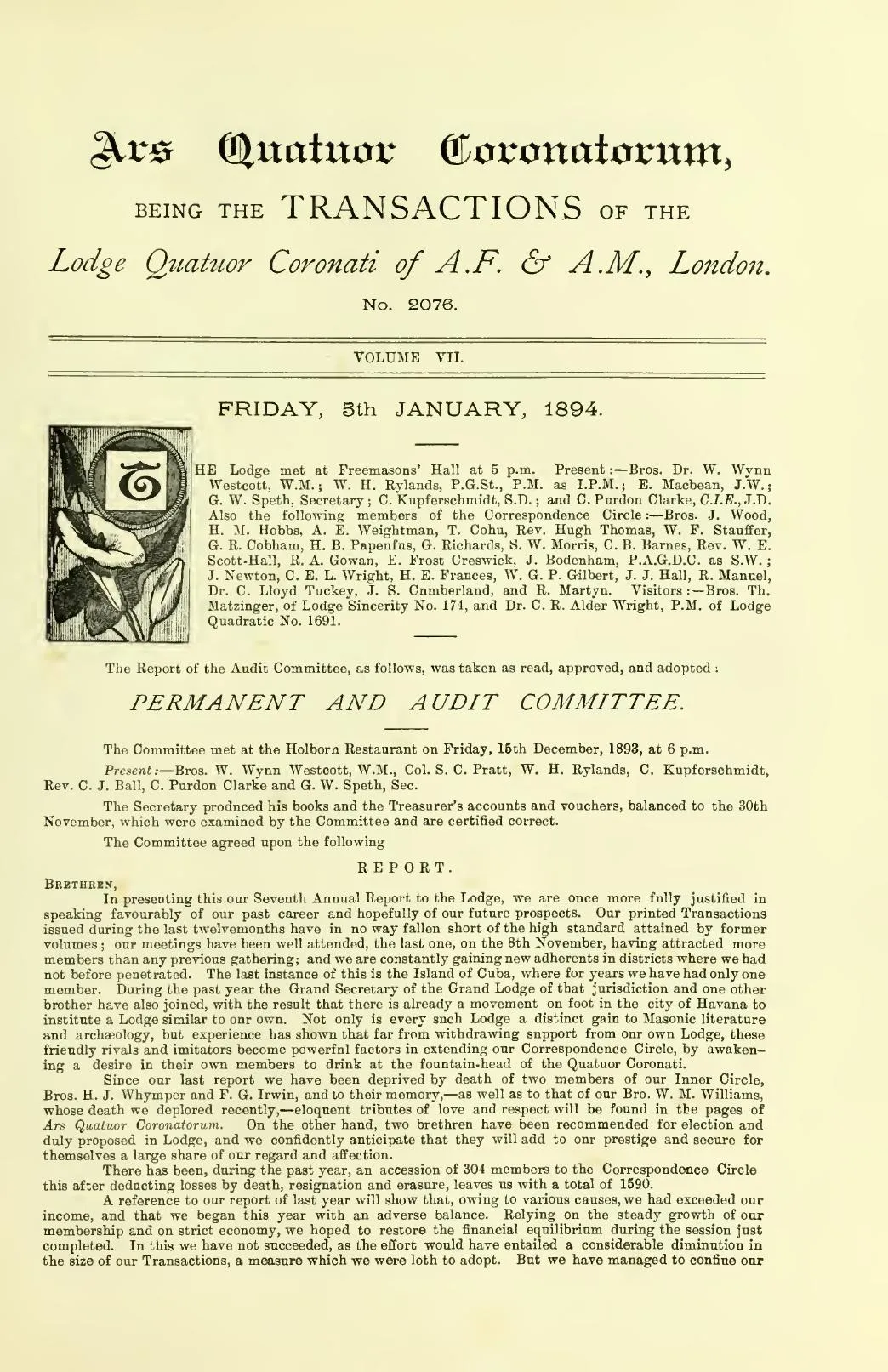
THE Lodge met at Freemasons' Hall at 5 p.m. Present:—Bros. Dr. W. Wynn Westcott, W.M.; W. H. Rylands, P.G.St., P.M. as I.P.M.; E. Macbean, J.W.; G. W. Speth, Secretary; C. Kupferschmidt, S.D.; and C. Purdon Clarke, C.I.E., J.D. Also the following members of the Correspondence Circle:—Bros. J. Wood, H. M. Hobbs, A. E. Weightman, T. Cohn, Rev. Hugh Thomas, W. F. Stauffer, G. R. Cobham, H. B. Papenfus, G. Richards, S. W. Morris, C. B. Barnes, Rev. W. E. Scott-Hall, R. A. Gowan, E. Frost Creswick, J. Bodenham, P.A.G.D.C. as S.W.; J. Newton, C. E. L. Wright, H. E. Frances, W. G. P. Gilbert, J. J. Hall, R. Manuel, Dr. C. Lloyd Tuckey, J. S. Cumberland, and R. Martyn. Visitors:—Bros. Th. Mattinger, of Lodge Sincerity No. 174, and Dr. C. R. Alder Wright, P.M. of Lodge Quadratic No. 1691.
The Report of the Audit Committee, as follows, was taken as read, approved, and adopted:
PERMANENT AND AUDIT COMMITTEE.
The Committee met at the Holborn Restaurant on Friday, 15th December, 1893, at 6 p.m.
Present:—Bros. W. Wynn Westcott, W.M., Col. S. C. Pratt, W. H. Rylands, C. Kupferschmidt, Rev. C. J. Ball, C. Purdon Clarke and G. W. Speth, Sec.
The Secretary produced his books and the Treasurer's accounts and vouchers, balanced to the 30th November, which were examined by the Committee and are certified correct.
The Committee agreed upon the following
REPORT.
BRETHREN,
In presenting this our Seventh Annual Report to the Lodge, we are once more fully justified in speaking favourably of our past career and hopefully of our future prospects. Our printed Transactions issued during the last twelvemonths have in no way fallen short of the high standard attained by former volumes; our meetings have been well attended, the last one, on the 8th November, having attracted more members than any previous gathering; and we are constantly gaining new adherents in districts where we had not before penetrated. The last instance of this is the Island of Cuba, where for years we have had only one member. During the past year the Grand Secretary of the Grand Lodge of that jurisdiction and one other brother have also joined, with the result that there is already a movement on foot in the city of Havana to institute a Lodge similar to our own. Not only is every such Lodge a distinct gain to Masonic literature and archæology, but experience has shown that far from withdrawing support from our own Lodge, these friendly rivals and imitators become powerful factors in extending our Correspondence Circle, by awakening a desire in their own members to drink at the fountain-head of the Quatuor Coronati.
Since our last report we have been deprived by death of two members of our Inner Circle, Bros. H. J. Whymper and F. G. Irwin, and to their memory,—as well as to that of our Bro. W. M. Williams, whose death we deplored recently,—eloquent tributes of love and respect will be found in the pages of Ars Quatuor Coronatorum. On the other hand, two brethren have been recommended for election and duly proposed in Lodge, and we confidently anticipate that they will add to our prestige and secure for themselves a large share of our regard and affection.
There has been, during the past year, an accession of 304 members to the Correspondence Circle after deducting losses by death, resignation and erasure, leaves us with a total of 1590.
A reference to our report of last year will show that, owing to various causes, we had exceeded our income, and that we began this year with an adverse balance. Relying on the steady growth of our membership and on strict economy, we hoped to restore the financial equilibrium during the session just completed. In this we have not succeeded, as the effort would have entailed a considerable diminution in the size of our Transactions, a measure which we were loth to adopt. But we have managed to confine our
[Page 27] — Transactions of the Lodge Quatuor Coronati. — 2
expenditure within the bounds of our receipts, or nearly so; and if we may assume that only one-half of the arrears are good,—a very moderate estimate,—then our position is a distinct improvement upon that revealed by our last balance-sheet.
A little good-will on the part of our numerous members would soon enable us to wipe out this deficiency and even place a handsome balance to our credit. We ask no sacrifice from them, but simply that each member desirous of helping us should either purchase one volume of the back Transactions or Reprints, and thus obtain excellent value for his assistance, or introduce one or two new members during the year.
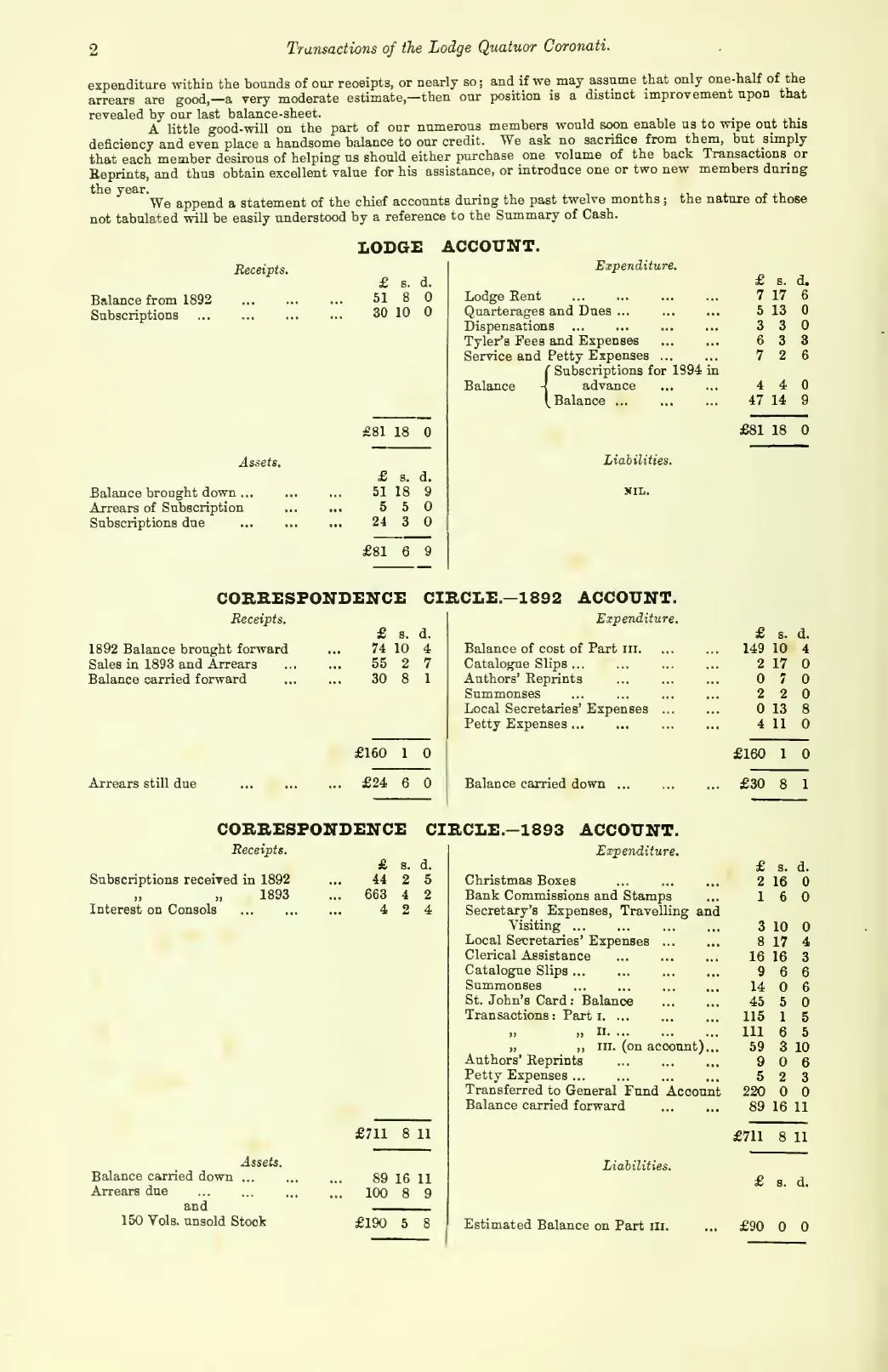
We append a statement of the chief accounts during the past twelve months; the nature of those not tabulated will be easily understood by a reference to the Summary of Cash.
LODGE ACCOUNT.
Receipts:
| £ | s. | d. | |
|---|---|---|---|
| Balance from 1892 | 51 | 8 | 0 |
| Subscriptions | 30 | 10 | 0 |
| Total | £81 | 18 | 0 |
Assets: Balance brought down £51 18s. 9d.; Arrears of Subscription £5 5s. 0d.; Subscriptions due £24 3s. 0d. Total £81 6s. 9d.
Expenditure:
| £ | s. | d. | |
|---|---|---|---|
| Lodge Rent | 7 | 17 | 6 |
| Quarterages and Dues | 5 | 13 | 0 |
| Dispensations | 3 | 3 | 0 |
| Tyler's Fees and Expenses | 6 | 3 | 8 |
| Service and Petty Expenses | 7 | 2 | 6 |
| Subscriptions for 1894 in advance | 4 | 4 | 0 |
| Balance | 47 | 14 | 9 |
| Total | £81 | 18 | 0 |
Liabilities: NIL.
CORRESPONDENCE CIRCLE—1892 ACCOUNT.
Receipts: Balance brought forward £74 10s. 4d.; Sales in 1893 and Arrears £55 2s. 7d.; Balance carried forward £30 8s. 1d. Total £160 1s. 0d.
Expenditure: Balance of cost of Part III. £149 10s. 4d.; Catalogue Slips £2 17s. 0d.; Authors' Reprints £0 7s. 0d.; Summonses £2 2s. 0d.; Local Secretaries' Expenses £0 13s. 8d.; Petty Expenses £4 11s. 0d. Total £160 1s. 0d.
Assets: Balance carried down £30 8s. 1d. Liabilities: NIL.
CORRESPONDENCE CIRCLE—1893 ACCOUNT.
Receipts: Subscriptions received in 1892 £44 2s. 5d.; " " 1893 £663 4s. 2d.; Interest on Consols £4 2s. 4d. Total £711 8s. 11d.
Expenditure: Christmas Boxes £2 16s. 0d.; Bank Commissions and Stamps £1 6s. 0d.; Secretary's Expenses, Travelling and Visiting £3 10s. 0d.; Local Secretaries' Expenses £8 17s. 4d.; Clerical Assistance £16 16s. 3d.; Catalogue Slips £9 6s. 6d.; Summonses £14 0s. 6d.; St. John's Card: Balance £45 5s. 0d.; Transactions: Part I. £115 1s. 5d.; " " II. £111 6s. 5d.; " " III. (on account) £59 3s. 10d.; Authors' Reprints £9 0s. 6d.; Petty Expenses £5 2s. 3d.; Transferred to General Fund Account £220 0s. 0d.; Balance carried forward £89 16s. 11d. Total £711 8s. 11d.
CORRESPONDENCE CIRCLE—1894 ACCOUNT.
Receipts: Subscriptions received in 1892 £17 9s. 11d.; " " 1893 £35 0s. 6d. Total £52 10s. 5d.
Expenditure: St. John's Card: Lithographing £9 9s. 0d.; Balance carried forward £43 1s. 5d. Total £52 10s. 5d.
REPRINTS—VOL. IV. ACCOUNT.
Receipts: Balance from 1892 £30 3s. 6d.; Subscriptions in 1893 £136 10s. 0d. Total £166 13s. 6d.
Assets: Arrears of Subscriptions and 50 Vols. unsold £19 8s. 6d.
Expenditure: Balance for facsimiles £75 2s. 0d.; Printing Circulars £1 0s. 0d.; Printing and Binding £31 11s. 0d.; Transferred to General Fund Account £59 0s. 6d. Total £166 13s. 6d.
Liabilities: NIL.
[Page 28] — Transactions of the Lodge Quatuor Coronati. — 3
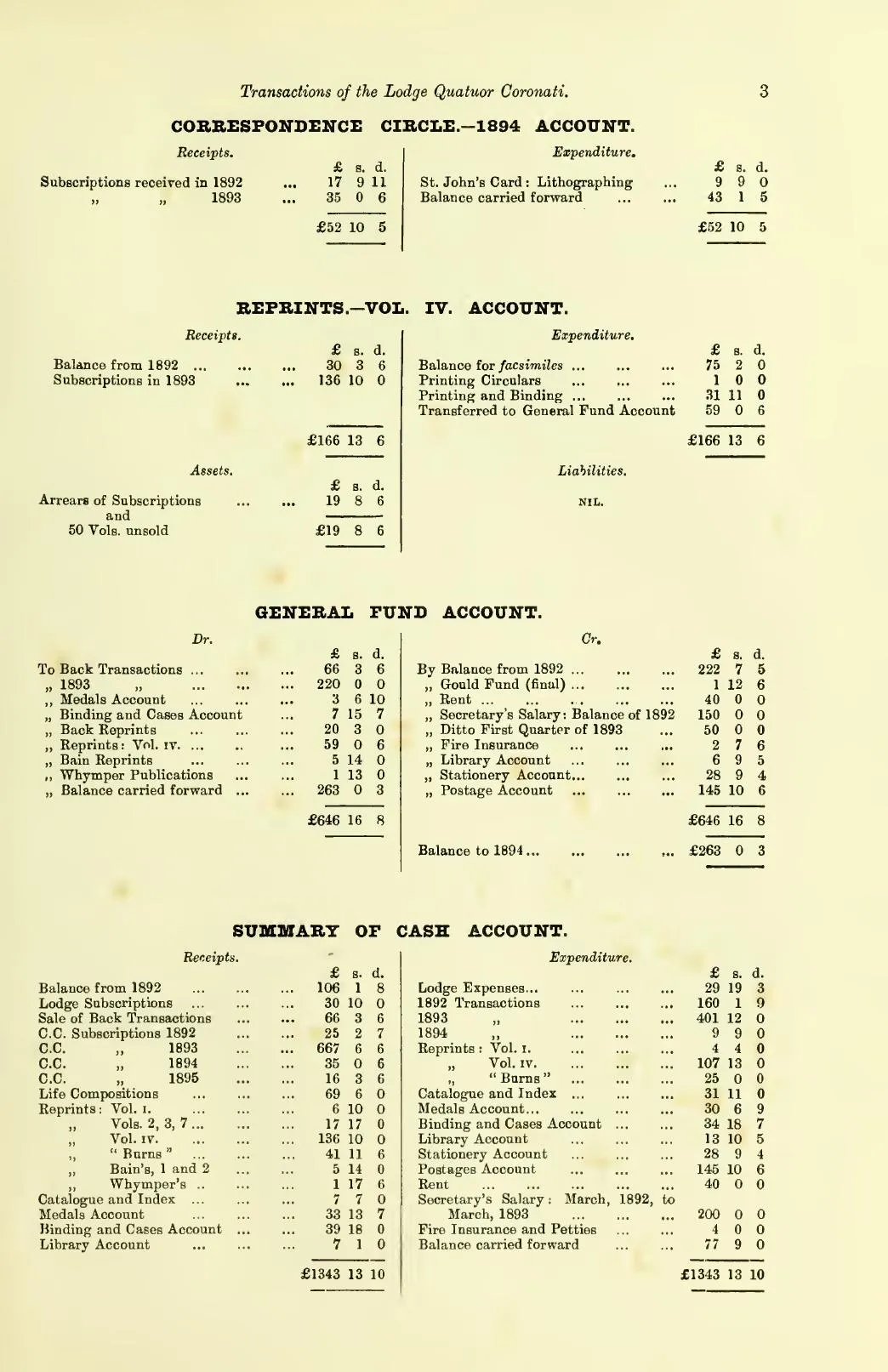
GENERAL FUND ACCOUNT.
| Dr. | £ | s. | d. | Cr. | £ | s. | d. | |
|---|---|---|---|---|---|---|---|---|
| To Back Transactions | 66 | 3 | 6 | By Balance from 1892 | 222 | 7 | 5 | |
| " 1893 | 220 | 0 | 0 | " Gould Fund (final) | 1 | 12 | 6 | |
| " Medals Account | 3 | 6 | 10 | " Rent | 41 | 0 | 0 | |
| " Binding and Cases Account | 7 | 15 | 7 | " Secretary's Salary: Balance of 1892 | 150 | 0 | 0 | |
| " Back Reprints | 20 | 3 | 0 | " Ditto First Quarter of 1893 | 50 | 0 | 0 | |
| " Reprints: Vol. IV. | 59 | 0 | 6 | " Fire Insurance | 2 | 7 | 6 | |
| " Bain Reprints | 5 | 14 | 0 | " Library Account | 6 | 9 | 5 | |
| " Whymper Publications | 1 | 13 | 0 | " Stationery Account | 28 | 9 | 4 | |
| " Balance carried forward | 263 | 0 | 3 | " Postage Account | 145 | 10 | 6 | |
| Total | £646 | 16 | 8 | Total | £646 | 16 | 8 |
Balance to 1894 ... £263 0s. 3d.
SUMMARY OF CASH ACCOUNT.
[Detailed cash summary showing total Receipts of £1343 13s. 10d. and matching Expenditure, with Balance carried forward of £77 9s. 0d.]
[Page 29] — Transactions of the Lodge Quatuor Coronati. — 4
BALANCE SHEET.
| Dr. | £ | s. | d. | Cr. | £ | s. | d. | |
|---|---|---|---|---|---|---|---|---|
| Lodge Account | 51 | 18 | 9 | General Fund Account | 263 | 0 | 3 | |
| Correspondence Circle, 1893 Account | 89 | 16 | 11 | Correspondence Circle 1892 Account | 30 | 8 | 1 | |
| " 1894 | 43 | 1 | 5 | Catalogue and Index Account | 24 | 4 | 0 | |
| " 1895 | 16 | 3 | 6 | Investments Account | 146 | 5 | 6 | |
| Life-members Account | 228 | 12 | 0 | |||||
| Whymper Reserve Fund | 105 | 15 | 1 | Cash, Balance in Bank | 45 | 19 | 1 | |
| Reprints "Burns" Account | 5 | 19 | 2 | " Balance in Hand | 31 | 9 | 11 | |
| Total | £541 | 6 | 10 | Total | £541 | 6 | 10 |
LIST OF ARREARS.
| £ | s. | d. | |
|---|---|---|---|
| Lodge Subscriptions, 1887 | 5 | 5 | 0 |
| Transactions, 1889 | 0 | 6 | 0 |
| " 1889 | 1 | 5 | 6 |
| " 1890 | 6 | 6 | 0 |
| " 1891 | 12 | 16 | 6 |
| " 1892 | 24 | 6 | 0 |
| " 1893 | 100 | 8 | 9 |
| Reprints, Vol. III. | 2 | 12 | 6 |
| " " IV. | 19 | 8 | 6 |
| " " VII. | 0 | 10 | 6 |
| Catalogue and Index | 5 | 15 | 6 |
| Medals | 2 | 14 | 0 |
| Binding and Cases | 3 | 10 | 6 |
| Total | £191 | 8 | 3 |
For the Committee,
WYNN WESTCOTT, W.M.
Seven Lodges, one Literary Association, and fifty-six brethren were elected to the membership of the Correspondence Circle.
Bros. Ladislas Aurele de Malczovich and Edward Conder Junior were elected joining members of the Lodge.
The SECRETARY read the following paper:
"FROM LABOUR TO REFRESHMENT" IN THE OLDEN TIME.
By Bro. W. FRED VERNON.
WHEN the Junior Warden rehearses the well-known formula as to his duty in the South, it sounds in the ears of the brethren of some lodges, where his column is never or very rarely raised, a somewhat meaningless and altogether unnecessary form. It must be understood that I am here and throughout this paper referring to the usages in Scotch lodges. But although it may seem so nowadays in a great measure, his duty as he states it, was at one time indispensable and imperative, for it would seem that "refreshment" formed a regular part of the proceedings in the olden time when a lodge was open, and as the W. Master and Senior Warden would have other duties to attend to, it was the Junior Warden's care to attend and look after the brethren, see that they had proper refreshment, and were ready to perform any duty when called upon. In the days of deep potations, now happily a matter of history, his office could have been no sinecure and he must have been sometimes very much exercised in keeping the brethren "within hail." When the custom of excessive drinking obtained in all classes of society it is not to be wondered at that in such a harmonious and social circle as the masonic brotherhood the conviviality would sometimes be deep and prolonged, and Burns bears testimony that he was:—
"Whiles daizt wi' love, whiles daizt wi' drink, Wi' Jads or Masons,"
[Page 181] *Plate — Table of Athelstan Legends*
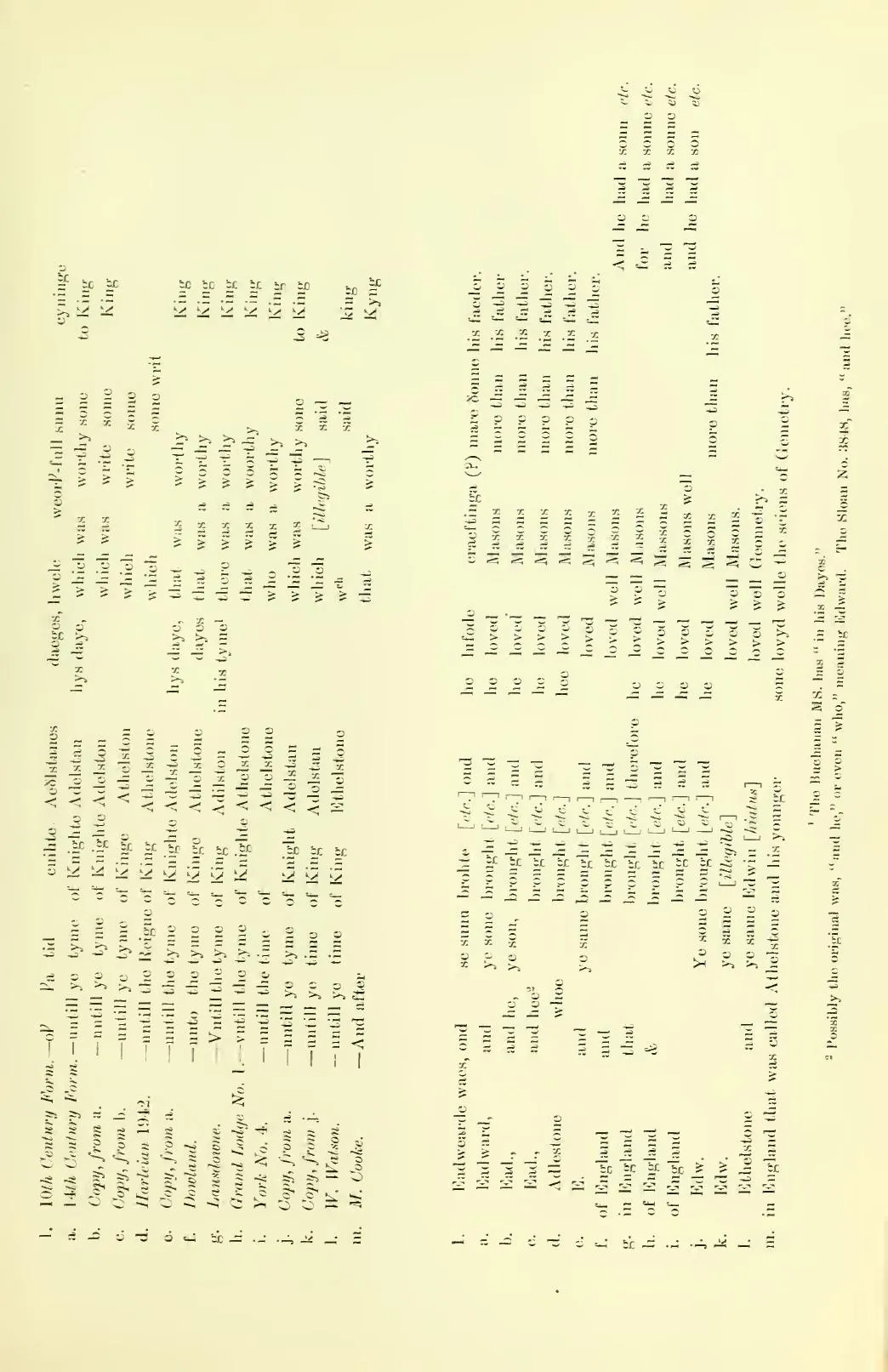
[Two side-by-side comparative tables of the Athelstan Legend as it appears in various manuscript constitutions]
Left table — 10th Century Form:
| Pa | lid | ||||
|---|---|---|---|---|---|
| I. | 10th Century Form. —untill yo tyme | of Knighte Adelstan | cnihte Æolstanes | cyuinge | |
| a. | 14th Century Form. —untill yo tyme | of Knighte Adelstan | to King | ||
| b. | Copy from a. —untill yo tyme | of Knighte Adelston | worthy | King | |
| c. | Copy from a. —untill the Reigne | of Knighte Adelston | Athelstone | some | King |
| d. | Harleian 1942. —unto the tyme | of Kinge Adelston | Athelstone | King | |
| e. | Copy from a. —unto the tyme | of Kinge Adelston | Adlelston | some writ | King |
| f. | Lansdowne. —untill the tyme | Adlelston | lys days. | King | |
| g. | Grand Lodge No. 1. —untill the tyme | of Kinge Athelstone | Athelstone | in his tyme† | King |
| h. | York No. 4. —untill the time | of Knight Adelston | Athelston | a worthy | King |
| i. | Copy from a. —untill yo tyme | of Knight Adelstan | Athelstone | who was a worthy | to King |
| j. | Copy from j. —untill yo time | of King | Adelstan | which was a worthy | king & |
| k. | W. Watson. —untill yo tyme | of King | Ethelstane | said | |
| l. | M. Cooke. —And after | that was a worthy | Kyng | ||
| we | |||||
| which | |||||
| who |
Right table — "Eadwarde waxs ond...":
| I. | a. Eadwarde | waxs ond | we sone broughte [etc.] ond | Some his fader, | |
| b. Ealward, | ye son, broughte [etc.] and | more than his father, | |||
| c. Ead, | and his, | brought [etc.] and | his father, | ||
| d. Athelstone | and hee | brought [etc.] and | his father, | ||
| e. E. | ye same brought [etc.] and | his father, | |||
| f. of Athelstone | whos | ye same brought [etc.] and | his father, | ||
| g. in England | and | ye some brought [etc.] | his father, | ||
| h. of England | that | brought [etc.] therefore | |||
| i. of England | & | brought [etc.] and | And he | ||
| j. Edw. | Ye some broughte [etc.] | for he | |||
| k. Edw. | and | ye same broughte [etc.] and | had a some etc. | ||
| l. Ethelstone | ye same Edwin [Edwinus] | and he had a some etc. | |||
| m. in England that was called Athelstone and his younger | some loved well Geometry. |
² Possibly the original was, "and he," or even "s who," meaning Edward. The Sloan No. 3848, has, "and hee."
[Page 182] *Blank page*

[Page 183] — The True Text of the Book of Constitutions (continued)
peace, and he loved well Masons and he had a son named Edwin."¹ I think the lost words came after the second "Ethelstone" (recte "Edward" or "Edw"), and were, "and he brought the land into good rest and peace and builded many [etc.] and," and that another omission, of the words "Masons more than his father, and was a great practicer of," occurred between the words "loved" and "Geometry."
Here, in some such transcriber's error as I have pointed out, was the inception, I believe of the whole Edwin myth; a myth which would rob Athelstan of half, and his great father of all his Masonic glory, in favour of a fameless Atheling—who, forsooth, is said to have "ordained" laws—or of the king of a rival state, who flourished three centuries before, and whose only claims to Masonic notoriety are that his name was Edwin and he built a wooden church! The Regius MS. knew not Edwin. The Cooke knew him not, although even in its day "Athelstan, son to Edward," or "Athelstan, Edward his son,' had become in some copies "Athelstan, Edw. his son," or "Athelston his son," but not "Athelstan his son Edw." That other copies were more correct, we know from the fact that MSS. of the much abused Roberts family preserved, centuries later, the true story, and joined with the Regius in declaring that it was Athelstan, "the King himselfe," that built "hye templos of gret honowre," that "loved thys craft ful wel," and that "a semblé" "cowthe let make."²
ATHELSTAN'S ASSEMBLY.
I shall not attempt to recover the exact language of the part of our book which tells what was done at the Great Congregation, but I desire to examine the subject in the light of the Cooke and Regius MSS.
It is clear to me that the authors of these histories intended to say the king summoned Masons together, and then held a witenagemot. "He sende aboute . . . after Witenagemot (67-74). After they had arrived, "A semblé" (viz., a witenagemot), "thenne alle the Masonus" to obtain the benefit of their "good consel" says the Regius he cowthe let make of dyvers lordis" (75-76). The Regius does not, and no contemporary chronicle would, expressly mention the Masons as taking part in this witenagemot, because that is taken for granted. There could not, of course, be a witenagemot without the presence of witen—"dyvers lordis"—but, on the other hand, the witenagemot of the tenth century retained so many of the characteristics of the older folkmot that the right of every Mason, or other freeman, to attend and take part in the deliberations of every witenagemot was fundamental and unquestioned. He was as much a constituent part of it as the greatest earl. The representative system was unknown. The witenagemot consisted of such lords and free commoners as chose to attend. Its decrees were made in the name of "Thaini, Comites et Villani," or of the King "cum tota plebis generalitate," and its proceedings were considered done "ab omni Anglorum populo." Freeman and Kemble make this too plain for further comment.³
First, then, it is clear that a civil, as distinguished from a Masonic, legislative body met. This meeting was public. It is not unreasonable to suppose that the Masons took advantage of the occasion to hold a private Masonic meeting also⁴; but we are at present concerned with the doings of the civil body only, for all the MSS. agree that it, although
¹ Quatuor Coronatorum Antigrapha, III., xvii. ² While I myself cannot escape the conclusion that the whole Edwin fiction arose from mistaking "Edw" for Edwin," or "Athelstan, Edw's son," or "Edw and the son" for "Athelstan's son" or "Edwin the son," yet there are other ways of accounting for it. As shown in the Spurious column in the text, the author of the Krause MS. referred to "Hadrian," and to the extensive building by an Emperor's son. There is no reason why others should not have done the same, centuries before. In fact we know that the intimation that the good rule of Masonry was destroyed until Athelstan's day, tempted the editors of several of our versions to point out instances of building before his day. If, upon any copy of the Constitutions, was noted, what the Krause MS. notes, that "churches were erected under the son of the Emperor who raised Masonry from the dust," to the inquiry, "What Emperor?" would be responded, "Athelstan," Basileus Anglorum simul et Imperator Regnum—"He raised Masonry from the dust." (For Athelstan's frequent use of the imperial title, see Freeman's Norman Conquest, I., Appendix B). "Who was his son?" The Atheling's name was Edwin. "Ah, Athelstan had a son Edwin who built churches." Or, in regard to Hadrian, the reasoning might run like this: 1—Hadrian built stone walls in the North (Eng Chronicle). 2—Athelstan invaded the North (Id.) 3—Perhaps Hadrian was his son. 4—Hadrian was his son (Sloan MS. 3848). 5—No, the Atheling, [heir presumptive] was named Edwin (Eng. Chron.) 6—He had a younger son (Cooke MS.) 7—If Edwin was the Atheling, it must have been he, not Hadrian, that employed Masons. 8—But Edwin Atheling died young (Eng. Chron.) 9—Then our Edwin must have been another Edwin—say Edwin of Northumbria! (Modern Guessers). If evidence should be forthcoming showing that in Athelstan's day there was an eminent ecclesiastic named Hadrian, a faithful "son" of the church and king, who was identified with building at York, I should see a fourth way of explaining the myth. ³ Norman Conquest, I., cap. 3, § 3; Saxons in England, II., 195. ⁴ There are intimations to that effect in some of the MSS. See Regius, l. 251; Cooke, ll. 827-830; and the use of the words "they contrived ye charges," in the W. Watson. We may be sure that if the civil power subjected them to such stringent enactments as some of the Articles given in the Cooke MS., for
[Page 184] — Transactions of the Lodge Quatuor Coronati. — 128
variously denominated by them "the semblé," "Assembly," "Congregation," "King," "Edwin," or "Knight Athelstan," gave the force of law to certain of the charges, and the first in importance in the minds of the civil authorities, was, that the King, or, if you prefer, the witenagemot gave the Masons—not ordinary Masonic Charges but—"the charge" (3), or "a charge" (13), one remembered long after as "a deep charge for observation of such Articles as belong to Masonry" (8); and "commanded that rule to be kept ever after" (28). This was in accord with the two purposes for which the assembly was held, to "amende defaultys," and to "ordeyne for these masonus a state"—that is, to give them organization. If a more full account of this matter was given in the original history, it dropped out of the ordinary versions by its own weight, for many reasons. It was long; it detailed many matters which were of common notoriety as long as the annual assemblies continued to be held, and some which began to be considered esoteric after that time; but, particularly, the "deep charge" contained legislation which was more in the interest of the employer than of the craft, and was also in derogation of the claim of the right to regulate within themselves all matters pertaining to the craft—a right which they claimed so persistently, citing precedents even back to Babel, that if anything is entitled to be considered a landmark, this claim seems worthy of that distinction. For these reasons, the average scribe was content to enlarge on the privileges granted in the charter, and abbreviate as to any restrictions put upon the craft by the civil authority.
But the Cooke and Regius MSS. profess to give fuller statements of this matter. I shall summarize the former, which is partially corroborated by the latter, without discussing whether the account given was drawn from actual records, or is a mere historian's version, like the speeches put by Tacitus and Bede into the mouths of their characters, or is a mere invention, although I incline to the second view.¹ The Cooke MS., which, singularly enough, does not refer to the great assembly itself at all, except by the faintest of allusions, declares that it was ordained by the civil power:
(1) That congregations of all masters Masons and fellows must be called by the masters in the several counties or provinces, annually or triennially.
(2) That at each congregation, a sheriff or other civil executive officer shall, if need be, be associated with the master of the congregation, to enforce his authority.
(3) At the commencement of the proceedings, new men who have never been charged before shall be charged to be not thievish but faithful to their employers, honest and loving toward their fellows, loyal, and to keep the articles.²
example the 8th and 5th, clearly made in the interest of employers, the Masons themselves would choose an early day to enact the 4th Point, that a Mason shall "susteyne none articles" (well paraphrased "enactments" by Bro. Speth), "ayenst the art, ne agenst none of the art."
¹ I know a man who objects to reading the Old Testament, because it makes him feel that there is no other book worth reading. Are we not all similarly affected, to a certain extent, by close study of a worthy subject? In obtaining the Regius, Cooke and Watson MSS, have we not secured, incidentally, a eulogist for each? Bro. Speth styles the second part of the Cooke, "the oldest and purest version" of the Charges, "neither more or less than the 'Boke of Chargys' itself." To him, "It stands alone,— "Like Adam's recollection of his fall."
It seems to me that recognition of our brother's extraordinary faculty—I had almost said instinct—of distinguishing truth from error, and of arriving at correct conclusions in doubtful cases, has led us to a too ready acquiescence in this conclusion. I tremble to stand alone against giants, but as a man and a Mason I dare not fail to say it seems very clear to me that lines 697-826 and 901-960 of the Cooke, separated in our version to permit the "Points" to be placed between them, originally formed a distinct document and a modern (i.e., 14th century) one, drawn with exceeding exactness and care, for some particular purpose—perhaps to be laid before unfriendly civil authorities. It is far too exact, methodical and accurate to have come down the ages with Geometria, Abraham, Englat, and "seynct and habelle." It shines, amid its homely surroundings, like a polished marble asher set in a wall of rubble. The adjoining stones are worn, and ground and scarred by the pressure of the glacier as they came down the stream of time. It, alone, is square and true and bright—the "purest" of all, as Bro. Speth says. But, in spite of its beauty, it was, to quote the same fascinating writer, "diverted into a back water, and [it] never reached the ocean"; it "was never handed down, and found no imitators." Why? Because, as I think, the Craft recognized it, not as a copy of their venerated Charges, but as the innovation of one who had undertaken, like Anderson, to "digest in a new and better method."
² From this, and the sentence next following in my text, the author of the Commentary on the Cooke MS. has drawn three very remarkable conclusions (Q.C.A., II., and A.Q.C., III., 28): First, "That the freedom of the Craft was conferred at these meetings only." Assuming that "charging new men" means conferring the freedom of the Craft, I fail to find in the MS. the slightest justification for the word "only." Second, That "charging new men that never were charged before" means, conferring the freedom of the Craft, i.e. freeing apprentices from their indentures; and, incidentally, that taking an apprentice meant making a Mason. But are there not numerous objections to this theory? Where is there the slightest evidence that apprentices were to attend these assemblies? When a
[Page 185] — Transactions of the Lodge Quatuor Coronati. — 129
(4) "They that be made masters" shall be there examined in the Articles, ransacked as to their ability and skill, and charged to well and truly expend their employer's goods.
(5) After that, inquiry shall be made as to whether any summoned master or fellow has broken any of the Articles.
(6) If any be found guilty of having done so, or have contumaciously disobeyed the summons, he shall forswear Masonry; or, neglecting to do so, shall be imprisoned, and his goods forfeited, by the civil authorities.
brother took an apprentice, did that make him ipso facto a member of our fraternity? Did releasing an apprentice make him ipso facto a fellow of the fraternity? Is not the charge prescribed for "new men," essentially less than the Charges of a Freemason? Finally, were apprentices "men who had never been charged before"? All these questions must be answered contrary to what seems to me the weight of evidence before Bro. Speth's second proposition can be allowed?
We have one charge as to taking apprentices, but an entirely distinct one as to making Masons. Within certain limits, any master or fellow could take an apprentice. If those limitations were respected, it was a mere business transaction between the two. But as early as 1583, the date of Grand Lodge MS. No. 1, a law had become so ancient as to be unintelligible to some transcribers, which required the consent of some of the fellows before the master could make his apprentice a "Masson," that is, a member of our fraternity. If the apprentice never became one of us, he probably became a "rough layer," or "cowan," or, in the delicate parlance of the modern trade union, a "scab." But what little evidence I have yet seen leads me to believe many apprentices became members of the fraternity—were made Masons—early in their term, or as soon as they were of lawful age; and this was, as I believe, the occasion when they were required to lay their hand upon a hook, and take upon them our solemn charges. Never, after that, could they be described as "men who had never been charged before."
When freed from their indentures, they became fellows of the craft, and at this point were probably taught the great lessons which we learn in the third degree. This step, I believe, they took in the local Lodge, and I see nothing in the Cooke MS. to indicate the contrary.
I think the requirement that new men should receive certain charges is to be explained in this wise: These legal enactments were drawn up chiefly in the interest of the state and the patrons, and, quite likely, by or under the supervision of officials who were not of the fraternity, and knew nothing of our secret obligations. They would be very particular to insist that the right to hold these annual meetings should be limited to men who had become obligated to "truly fulfile here dayes werke and truayle for here pay," and "he trewe to the kynge of englond and to the reme." Perhaps, also, they had found, among the operatives summoned by Athelstan, some who were not of our fraternity?—"men who had never been charged before"—and had seen them obligated. Athelstan "made many Masons," say some versions. On the other hand, far-seeing members of the fraternity could laugh in their sleeve to see this clause inserted, perceiving how they could turn it against cowans, and have a monopoly of the right to hold meetings. The monopoly became established in a few years, the provision ceased to be of importance, and a record of its existence survived in but one MS.
Third, Bro. Speth assumes that the examination of those "that be mad masters" meant the examination of apprentices that are to be made masters, by being freed from their indentures. But is this possible? Does a butterfly hatch from the butterfly's egg? Was an apprentice suddenly converted into a Master? Master of what? Of what Lodge, or of what workmen? Artemus Ward, I believe, told of what it was, that was ever a Lodge of Masons which consisted of Masters and apprentices. For a thousand years, no one ever looked into a lodge or workshop of stonemasons without seeing three classes of workmen, apprentices, journeymen, and a boss. There is not a page of our Old Charges which does not allude to three classes of workmen, apprentices, fellows and masters. I am not speaking of Masonic degrees, but of classes of Masons. The apprentice became a fellow, but not a master. The "connynge were called maister"—the "lasse of witte" were called "felaus" (Cooke MS., 678-686). Probably nine-tenths of the fellows never became masters; but one who was ambitious and "more skilful than the rest" might "attain that high and honourable distinction," might acquire the right to take contracts, employ workmen, receive his fellows' pay from the patron and distribute it to them, and be called "Master" during the progress of the work.
That it was intended, by the civil authorities who inspired the clause in question, that the qualifications of those who aspired to, or had been elected to, these responsibilities should be tested in these annual meetings, I do not doubt. Nay, I will go farther: It is not at all unlikely that, just as freemen renewed the oath of fealty annually, it was intended that all masters should annually prove their fitness for their office, and he charged to "welle and trewly dispende the goodys of here lordis." Whether or not the fraternity quietly ignored this law, is another question. But, that apprentices were passed in the annual assemblies only; or were jumped into the office of master (I do not mean occasionally, but necessarily); or that all fellows were masters, is, it seems to me, not even intimated in the Cooke MS., or in any other that I have seen.
Thus far, I have kept "within the record," as we lawyers say; but if I may add a mere conjecture, not, however, unsupported by fragments of evidence, I would say that, with my present light, I am inclined to think that, anciently, an operative Mason's history was as follows: (1) He was apprenticed to a Mason by a civil contract, remaining a profane. (2) If found worthy to become a member of our fraternity, he was sworn upon a hook, and charged. This could happen either during or at the close of his civil apprenticeship, and did not affect the latter. (3) When released from his indenture, if he had been so charged, he became a fellow, and was entitled to the lessons now taught in the third degree. (4) If made a Master, some ceremony followed—a ceremony of which I believe the private part of the 18th century installation service, and the ceremony of "passing the chair" are reminiscences, if not survivals. To this ceremony, and not to our third degree, or ceremony of "passing the chair" are reminiscences, if not survivals. To this ceremony, and not to our third degree, I think Dermott alluded when he claimed that the "Moderns" were ignorant of "the Master's part."
Curiously enough, very recently several Grand Lodges have enacted that no Master elect shall be installed until he has proved his knowledge of all the work and lectures of the degrees, thus reminding us of the provisions of the Cooke MS., that masters "he ransakyd whether thei be abulle and kunnynge."
[Page 186] — Transactions of the Lodge Quatuor Coronati. — 130
The Articles alluded to, nine in number, are set out in full in the Cooke. They are, with a few exceptions, well-known "old charges." The Regius differs, in having fifteen Articles, and in appearing to ascribe to Athelstan's Assembly fifteen Points also, which are also in the main, "old charges." The Cooke MS. gives nine Points, but does not connect them with this Assembly.
Probably our original declared, as a second thing done at the great assembly, that the charter to keep, and made an ordinance that it should be renewed from king to king" (2). A lawyer, attempting to make a strong case for the Masons,
The Charter. would not have used words implying that a renewal was necessary. The idea of the Regius shows more worldly wisdom—that every future Assembly was commanded to beseech the king to "conferme the statutes of kynge Adelston." It will be remembered that the Regius does not mention any charter; and it is by no means impossible that the charter and the decree of the great assembly were one and the same instrument—in other words, that the "certain rule" mentioned in the second part of the Cooke MS. as ordained in the time of King Athelstan, was incorporated into the "free patent" mentioned in the first part of the Cooke. But it is quite evident that the transcribers and editors of our ordinary versions—our Constitutions proper—thought otherwise. I believe they, or their original, attributed the charter to a date anterior to the death of King Edward, and probably made it a grant from him to Athelstan.
Our book next undoubtedly declared that "he made a cry that all old Masons [? or young] that had any writing [? or understanding] of the charges and the manners that were
Old MSS. made before in this land [? or in any other], that they should bring them forth" (2); and that some were found in various languages, of which our original mentioned English and French, probably Latin, and possibly others; and that "the intent thereof was found" (10)—not "found to be one"—" and therein he commanded a book to be made"—not a book of charges, although the older books consulted were primarily books of charges and manners, but a book "how the craft was first found"—"and commanded that it should be read or told when any Mason should be made" (2), "and to give him his [i.e., the candidate's] charge" (9).
Here, I think, ended not only what our book had to say of the Great Assembly, but the book itself. It is quite possible that it agreed with most, if not all, of the existing versions in declaring that at that assembly the king "made many Masons," but I can find no warrant for the statement of the W. Watson that "he ordained that such congregation might be called Assembly and he ordained for them good pay." To claim that every friendly monarch, since Nimrod, ordained good pay, seems to have been almost a landmark with our ancient brethren. The word "Assembly" was unknown to the English tongue in Athelstan's day. Possibly the scribe of the Watson followed a version which read "called to assemble." The clause in regard to making Masons possibly refers only to the fact that if among the operatives summoned by the king there were some who had never been charged, or become members of our fraternity, one of the first steps would be, naturally, to receive them into our ranks.
MANNERS AND CHARGES.
To the narrative which we have been considering, would naturally be appended, in time, two other books, one comprising the Charges, and the other the Manners of the Masons. It is not my purpose to review these at this time, but I wish to say a word concerning each. The Manners were, in my opinion, exactly such treatises on good behaviour as we find composing the latter part of the Regius MS. They seem to have become nearly obsolete at a very early day, and, although the word frequently occurs in our old constitutions, its Masonic meaning was evidently unknown to many of the transcribers. Nearly all of section "VI., Of Behaviour," published in the Constitutions of 1723, is made up of old "Manners"; and a last survival of the institution is doubtless preserved in those almost puerile cautions against ungentlemanly conduct during sessions of the Grand Lodge, to be found in the By-Laws of some Grand Lodges.
The Charges seem, from a very early day, to have been divided into two parts, "Articles" and "Points," "Charges General" and "Charges Singular," "Charges" and "Other Charges," but the basis of the division is not absolutely certain, and was evidently unknown to early transcribers, some of whom seem to have supposed it to have been the difference between moral and trade duties; others, between charges for all Masons and charges for operatives only; and others, between ancient and recent charges. What seems to have been the theory of the compiler of the second part of the Cooke MS., that the articles were intended for Masters only, seems to me the least tenable of any. If it is not contradicted by his own statement that new men must be charged to "keep alle the articles," it is by the Regius, which gives two "Articles" (the 11th¹ and 12th), which apply not merely to Masters but to every Mason; and, in ll. 409, 479, seems to imply that the second article of the Cooke—that Masters shall be forewarned to come to the assembly—applies equally to fellows. This, indeed, is shown by the language of another part of the Cooke itself (ll. 901-903), "Whan the master and the felawes, be forwarned, ben y come," the sheriff shall, etc. The view, which however is not supported by the Regius, that the Articles these charges which had been given the force of secular law by the civil power at the Athelstan assembly, is exceedingly plausible, and if it be the true one, the fact that, as early as the date of the MSS. from which the originals of the Regius and Cooke were compiled, there were at least two theories as to which of the charges deserved to rank as Articles, indicated that a long period of time—several centuries, I should think—had elapsed since the day when that rank was conferred. Thus, little by little, does evidence accumulate tending to show that our old books were, like Herodotus and Berosius, often speaking truths when we doubted them most; and warning us that when they tell us of a great assembly in the tenth century, we should pause before too confidently rejecting their tale.
[Page 187] — Chinese Secret Societies — 131
CHINESE SECRET SOCIETIES.
BY BRO. J. COPLEY MOYLE, P.M., D.D.G.M., and D.G.H., Burma.
Barrister-at-Law and Government Prosecutor, Moulmein.
AT page 194, vol. VI., A.Q.C., illustrations of two prints in Chinese characters are given which Bro. Campbell suggests have reference to the admission into some secret society, probably that of the "Black Flags," and asks if further light can be thrown on the subject. Bro. Campbell's conjecture is probably correct, as the inscriptions appear to be similar to verses in the writer's possession, recited at the initiation of a candidate into another society—the "Ghee Hin"—said to be an offshoot originally from the Society of the Black Flags. As so little is generally known about the initiatory ceremonies and rules in use in Chinese Secret Societies, the following particulars may be read with interest.
It may be remembered that the "Black Flags" were very much in evidence when fighting against the French in Annam, about ten years ago. They, like all existing Chinese Secret Societies, are opposed to the existing Manchu Dynasty, and have been already so successful that they have in certain provinces of China established an imperium in imperio, where they reign virtually supreme and their fiat is law.
The most powerful Secret Societies in China at the present day are the "Tien-ti-Hwing," or "Union of Heaven and Earth" (having for the same object the overthrow of the Manchu and the restoration of the last Chinese Dynasty of the Ming), and the "Triad Society," which has its ramifications throughout Annam and Cambodia, and more would doubtless have been heard of this Society if the French had met with any check in Siam. Another Society, which is known as the "White Lily," is also very powerful, its members being generally credited with magical powers.
The "Ghee Hin" Society above mentioned has certainly existed for several centuries, and was founded for the purpose of overthrowing the Tartar rule and replacing the Ming Dynasty on the throne of China, and the Society has its branches in Burmah and the Straits Settlements. It is governed by three Principals or Headmen, who are assisted by Councillors, the former being elected for life. To the Secretary is left all the routine business of the Lodge. It is impossible to estimate the total number of members at present belonging to the Society, but the number must be very large, as in 1867 the number in Penang alone was estimated at 26,000, and the Society had at that time, besides its Lodge building, property worth over 20,000 dollars, invested in houses and lands in the Province of Wellesley. The fee levied for initiation into the Society is stated to be $3.60, in Penang, but at the present time in Burmah the fee is, I am informed, 24 rupees.
After paying this fee the candidate for admission is informed of the date and time he must attend at the Lodge. He is received at the entrance by certain members with drawn swords, and upon admission is required to take a particular oath. Blood is extracted from one finger of his hand and mixed with spirits and water in a bowl, from which the candidate and all the members present drink. At the same time a white cock is decapitated and a Chinese priest recites verses at great length, very much in character like those given at page 194 of the Ars. The practice of decapitating a cock when administering an oath of more
[Page 188] — Transactions of the Lodge Quatuor Coronati. — 132
than usual solemnity is common among the Chinese. The common form, however, in Burma is setting fire to a slip of yellow paper on which is printed a form of words, but in India breaking a cup inside or just outside the Court is the more usual form of taking the oath, the meaning being symbolical and to the same effect in each case, namely, that as the cock was killed, the paper burnt, or the cup broken, it is imprecated that the party taking a false oath may likewise perish.
The following particulars, given by a witness subpœnaed to give evidence before the Commissioners appointed under the "Penang Riots Enquiry Act" (XXI. of 1867), will serve to describe an initiation into the above Society (premising only that the witness in his evidence does not refer to himself alone, but to a number of candidates who were admitted to the Society on the same occasion).
"At 11 o'clock" (the witness deposed) "we were taken into the 'Kongsee' house [Lodge] two by two, passing through four doors successively after certain questions were asked and answered at each of the doors, two guards being stationed at each door.
"At the first and at the other three doors we were asked:
Q. Where do you come from? A. From the East. Q. For what do you come here? A. We come to meet our brethren. Q. If the brethren eat rice, mixed with sand, will you also eat of it? A. Yes, we will. (The doorkeepers then showed a broad-bladed sword and asked)— Q. Do you know what this is? A. A knife (pisan). Q. What can this knife do? A. With it we can fight our enemies or rivals. Q. Is this knife stronger than your neck? A. My neck is stronger."
The candidate was told what answer to make and afterwards was allowed to enter. The secretary was standing upon a table, while another person was standing on the ground, in front of him, beside a tub of water.
The secretary ordered this person to prick the third finger of the left hand of the candidate with a needle, and the blood that trickled from it was allowed to drop into the tub of water.
After this the candidate was made to pass under another and higher table, behind the secretary, and upon which there was a Joss (Chinese god), where the candidate received three cents, and was told to go to a small charcoal fire at the back, and step over it, the left foot first. Near by were three square blocks of granite, on which the candidate was made to step with the left and right foot alternately. After passing these blocks, the candidate was conducted to a man who kept a kind of shop and received the three cents that had been given to the candidate, who got in return some cigarettes, Sirih leaves, and sweetmeats. There the candidate waited until all the new members had come up, when all were led round in front of a Chinese altar with a Joss on it. There all the candidates knelt, rose again, and from the tub each drank a little of the water, in which had been mixed the blood dropped from the fingers of all the new candidates, after which the candidates retired to a back room, and again returned to the altar, where the secretary was standing dressed like a Chinese priest, and all the candidates knelt whilst the secretary read, in Chinese, from numerous folds of red paper. Having finished reading, a fowl's head was cut off, and the secretary burned the papers he had read. When the fowl's head was cut off, the candidate was told that if he did not obey the rules of the Society he would meet the fate of the decapitated fowl.
The oath administered contained 36 articles, and would take up too much space to set out at length, but punishments differing in severity from death to beating and fine were annexed for transgressing particular articles. Members were required by the oath to consider and treat the father and brother of another member as their own. To rise and join the standard of the "true Lord" of China when he should appear. Not to reveal the secrets of the Society, nor to show its diploma or statutes to anyone. To relieve a member in distress. Not to seduce a member's wife (death being the penalty imposed for the infraction of this article). To give money to enable a member to escape from justice. Not to cheat or rob a brother member (penalty attached, loss of one or both ears). Ridiculing a member on account of his poverty was made punishable with 36 blows. To keep secret the fact that a member smuggled opium (penalty for breaking this article being the loss of ears and 108 blows). A member was also forbidden to marry the widow of another member, and severe penalty was to be inflicted on anyone who repented of having joined the Society.
At the present day the only punishment inflicted in any Chinese Society existing under British rule are fine and flogging, the latter being, however, extremely rare. A member
[Page 189] — Transactions of the Lodge Quatuor Coronati. — 133
of one Chinese Secret Society cannot join another until he has severed his connection with his former Society. Before a member can propose a candidate for membership he must have been a member of his own Society for at least one year. Office in the Society can be held by members only after a certain length of membership.
The rules and ceremonies above described are believed to be very similar in other Chinese Secret Societies. One reason for this is that many societies under different names exist which are the offshoots merely of the parent Societies. Thus the Toh-Peh-Kong Society was instituted fifty years ago in Penang owing to a dispute among certain members of the Ghee Hin Society, and the dissatisfied members left and set up the new Society, carrying with them the rules and ritual of the parent Society. In revenge for this, the Toh-Peh-Kong Society enacted that any of its members who should join the Ghee Hin Society should forthwith be expelled from the Toh-Peh-Kong. Again, every Society has its own distinguishing flag or banner and its own secret signs, by means of which its members may be known to one another. The following were some of the secret signs of the "Kyan Taih" Society as given in evidence by a witness in the commission already referred to.
How in offering a pipe to distinguish a member. If a pipe be offered, the same being held between the thumb and finger of both hands and both thumbs turned upwards and a member press the offerer's thumbs and touch his teeth with the end of the pipe before lighting it is sufficient.
How in offering tea to distinguish a member. Three fingers must be used only, and if the cup is returned in the same manner it is sufficient.
How in offering rice. Place chop sticks across the rice, and if the same be pushed away it is sufficient.
How to distinguish a member on a dark night. Pull the member towards you and then speak in two different voices.
How to distinguish a member who has committed a murder. The member having cut off some of his hair must tie it round his right arm, and when he seeks refuge or assistance he must wipe his left eye.
For recognition of a member. The right hand is to be passed over the eyebrows as if wiping them, passing the forefinger between the lips at the same time.
The "Triad" Society has its ramifications at the present day in Siam and Cambodia, and a recent number of the Courrier d'Haiphong gives particulars of an insurrectionary plot just discovered against the French in Annam. The conspiracy was of a formidable nature, and had been carried out with the utmost secrecy. Part of the design was to cut off the retreat of the French after they had invaded Siam, and further investigation proved that the Chinese provinces of Annam and Tonquin under French rule are now completely honeycombed with Chinese Secret Societies affiliated to the Triad Society. Ostensibly, like other Chinese Secret Societies, the Triad Society exists principally for charitable purposes, but in reality its real object is, like theirs, purely political.
[Masonic square and compasses emblem]
[Page 190] — Notes in Reference to H.A.B. — 134
NOTES IN REFERENCE TO H.A.B.
BY BRO. JOHN YARKER, P.M.
HERE is in course of publication in the American Boletin of the Spanish Masons, an article which again calls attention to a subject which engaged the pen of a Jew of the name of Joel Nash, who printed a pamphlet in 1836 upon the subject; and I have recently met with an article upon architecture, written by Mr. H. W. Brewer, which embodies the same idea. The first-mentioned article is entitled Habonim Hahophschim, a translation from the Hebrew.
My object in this short article is to attract the attention of Masons to the point raised, and to elicit the views of such linguists as Bro. Ball (who recently gave us a paper upon the Hebrew words in our rituals), as these three writers argue that there were two Hirams, father and son, besides Hiram, king of Tyre.
Mr. Brewer contends that the addition of the word "was" (a verb not here in the Hebrew) has confused the sense, and that the passage, 2 Chron., ii., 14, should read, "The son of a woman of the daughters of Dan, and his father ( . . . ) a man of Tyre," thus alluding to father and son, whom the king of Tyre sent to Solomon. Brewer appears to consider that the outside of Solomon's Temple was what we might now consider a third-rate conventicle of wood, but that the internal accessories were of the most magnificent description.
Bro. Nash argues that the Biblical writer is purposely reticent upon a point interesting to all Masons. Again, 2 Chron., iv., 11, it is said that "Huram did make the pots" (but) "Hiram finished the works that he was to make," and again two different persons are alluded to in v. 16, "the pots also and the shovels did Huram, his father, make for king Solomon," and the writer adds, "it is therefore evident that the father was the modeller, and his son Hiram only the finisher, and that in the Hebrew copy there is a difference in spelling." It is further said in 1 Kings, vii., 14, that he (Hiram) was a widow's son of the tribe of Napthali, and that hence he could not be the same man as Huram of the daughters of Dan. Hence Nash holds that whilst the father (Abif) was a more accomplished man than his son, some accident happened him, and the son finished his work, and no doubt returned to Tyre. Apropos, he points out that Succoth and Isărădātha respectively signify Booths (or Lodges), and sorrow, trouble.
The writer of the Hebrew paper just mentioned advocates further that Huram learned the profession of an architect in Egypt, and that the legend of the third degree is founded on an actual occurrence. Renan has shown that Egypt supplied architects to Tyre, but unless there is something in the Talmud to support the idea, we can only look upon the Egyptian pupilage as probable.
I may add to this that it is said of the elder Huram (if indeed there were two) that he was "skilful to work in gold, in brass, in iron, in stone, and in timber, in purple, in blue, and in fine linen, and in crimson; also to grave any manner of graving, and to find out every device that shall be put to him." Hence it would appear that he was rather a chemist, or even an alchemist, than a practical Mason. This brings me to the fact that middle-age Alchemists used the same symbols as modern Freemasons, so much so, that it is in some cases difficult to distinguish between the two; that in the 15th, 16th and 17th centuries Freemasons are accused by some of searching into the Secret Chemy. Again, if Manus Græcus is the Marcus Græcus of the 8th century, he was rather an Alchemist than a Mason. I do not doubt that modern Freemasonry has a Guild origin, and I am disposed to think that in all time the Society of Geometricians, builders in stone and wood, etc., were also chemists. For instance, Castle Rushen, in Man, built of limestone, must have had some chemical applied—built as it was about 1000 years ago—to put on the limestone blocks a hard glaze, which has rendered the stones absolutely indestructible by the elements. Modern architects cannot do this.
My aim in this short article is to call attention to certain difficult points in Masonry, upon which modern lecturers have not attempted to enlighten us, and I hope they will do so.
[Page 191] — The Two Saints John Legend — 135
THE TWO SAINTS JOHN LEGEND.
BY BRO. JACOB NORTON.
SO far as I have been able to discover, the first mention of the Grand Mastership of the Evangelist is contained in Moore's Masonic Magazine, printed in Boston, Mass., in 1842. Moore gave it as a Masonic tradition preserved in the English Lodges, but not known in America.
In his Lexicon of Freemasonry, 1845, Mackey introduces the legend in these words: "With respect to the original cause of this dedication (of the Lodges to the SS. John) the English Lodges have preserved a tradition, which, as a matter of curiosity, may find a place in this work. I am indebted for it to Bro. Moore's excellent Magazine, vol. II., p. 263.
"From the building of the first temple at Jerusalem to the Babylonish captivity, Freemasons' Lodges were dedicated to king Solomon; from thence to the coming of the Messiah they were dedicated to Zerubbabel, the builder of the second temple; and from that time to the final destruction of the temple by Titus, in the reign of Vespasian, they were dedicated to St. John the Baptist. But, owing to the many massacres and disorders which attended that memorable event, Freemasonry sank very much into decay and many Lodges were entirely broken up, and but few could meet in sufficient numbers to constitute their legality. At a general meeting of the Craft, held in the city of Benjamin, it was observed that a principal reason for the decline of Masonry was the want of a Grand Master to patronize it; they therefore deputed seven of their most eminent members to wait upon St. John the Evangelist, who was at the time Bishop of Ephesus, requesting him to take the office of Grand Master. He returned for answer, that though well stricken in years, being upward of ninety, yet having been in the early part of his life initiated into Masonry, he would take upon himself that office: he thereby completed by his learning what the other St. John had begun by his zeal, and thus drew what Freemasons call a 'line parallel.' Ever since which, Freemasons' Lodges in all Christian countries have been dedicated to the one or the other, or both of these worthy and worshipful men."
It is needless to go into the subsequent history of this legend. Admitting that from at least the time of the 1723 Book of Constitutions, the SS. John were honoured by the Masons
[Page 192] — Transactions of the Lodge Quatuor Coronati. — 136
in having the meetings of Grand Lodge held on their days, my object is to discover the origin of the tradition, if such it be, that the Evangelist was made a Grand Master in his old age, being over ninety, or indeed at any other time. That the tradition was not known in Moore's time in America, I gather from the following considerations.
Firstly: The Rev. Dr. Theodore Harris, the most famous American Masonic historian and essayist of the last century, to whose profound learning and research the world is indebted for the valuable information that Joseph in Egypt was the original founder of Freemasonry, did not know in 1798, when he published the second edition of his Masonic History, that the Evangelist was made a Grand Master, being upwards of ninety years old.
Secondly: Thos. Smith Webb, to whom we are not only indebted for the American Masonic ritual, but for making new Masonic degrees too, does not mention in the first edition of his Monitor, 1797, the name of St. John, either in the ceremony of constituting Lodges or that of dedicating Masonic Halls, whence we may conclude that up to 1797 American Lodges were not dedicated to St. John, at least not in Albany, New York, and Rhode Island where Webb resided and held Masonic offices. In the second edition, 1802, and the third, 1805, the name of one St. John is mentioned in both the above ceremonies. In the 1808 edition the "parallel lines" appear, and Webb gives as a reason for dedicating the Lodges to the Saints John, "Because they were both eminent patrons of Masonry," but he knows nothing of the tradition that the Evangelist was made a Grand Master.
Thirdly: Webb died in 1819 and was succeeded by Jeremy L. Cross as a ritual improver and instructor. Cross discovered a tradition that king Solomon erected a monument to the memory of H.A., showing a "virgin weeping and a broken column," but I could not find in Cross's Monitors printed before 1842 or sometime after 1842, the story of St. John the Evangelist and the Grand Mastership.
Fourthly: The great Frederick Dalcho, the first Sovereign Grand Commander of the very first 33rd degree in the history of the world, who edited an Ahiman Rezon for South Carolina in 1822, who had visited England and was undoubtedly the best informed Mason of his generation, even Dalcho did not know that the Evangelist was ever a Grand Master.
Fifthly: Twenty-seven years ago a member of Massachusetts Lodge, Boston, who was initiated in 1818, told me that the Evangelist tradition was not introduced into American Boston Lodges till years after his initiation.
Lastly: Moore himself acknowledges the legend was not preserved in America, and Mackey frankly avows himself indebted to Moore for his information.
Was it known previously in England? Oliver in one case evidently goes to American sources for his inspiration, and in the other case, writing after the date of the American publication, he gives as his authority an old York Lecture, THE York Lecture par excellence, and discloses a great deal more about past dedications and titles of Masons than even Moore knew. Did this lecture really exist? Does any Brother know of it? Can any Brother point out to me any hint of the legend before Moore introduced it? If Oliver's lecture existed when he wrote, not fifty years ago, surely somebody must know something about it. And if no information be forthcoming, and I personally have failed to find any, I shall believe that Moore invented the legend, that his "York Lecture" is as much a creature of his own vivid imagination as so much else of what he wrote. In that case, may we not call Moore and Oliver the two lines parallel of Masonic tradition, inasmuch as Oliver finished by his learning what Moore began by his zeal? But, joking apart, I shall be anxious to learn whether any member of the Quatuor Coronati can refer me to any earlier hint of the Grand Mastership of the Evangelist.
[Page 193] — Random Courses of Scottish Masonry — 137
RANDOM COURSES OF SCOTTISH MASONRY.
BY BRO. C. N. McINTYRE NORTH,
P.M. 1559, I.P.Z. 1275.
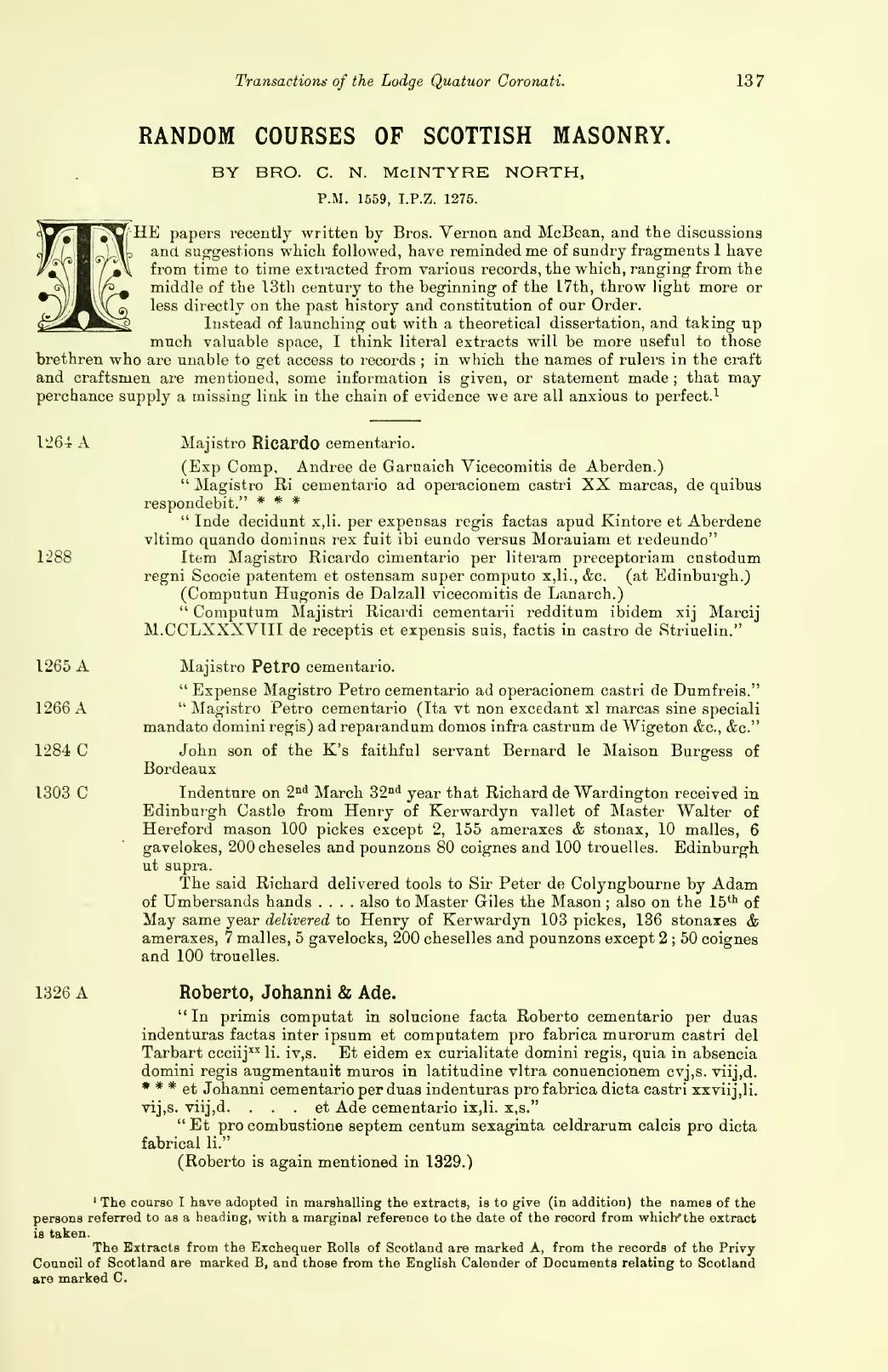
THE papers recently written by Bros. Vernon and McBean, and the discussions and suggestions which followed, have reminded me of sundry fragments I have from time to time extracted from various records, the which, ranging from the middle of the 13th century to the beginning of the 17th, throw light more or less directly on the past history and constitution of our Order.
Instead of launching out with a theoretical dissertation, and taking up much valuable space, I think literal extracts will be more useful to those brethren who are unable to get access to records; in which the names of rulers and craftsmen are mentioned, some information is given, or statement made; that may perchance supply a missing link in the chain of evidence we are all anxious to perfect.¹
| Date | Content | |
|---|---|---|
| 1264 A | Majistro Ricardo cementario. | |
| (Exp Comp. Andree de Garnaich Vicecomitis de Aberden.) | ||
| "Magistro Ri cementario ad operacionem castri XX marcas, de quibus respondebit." * * * | ||
| "Inde decidunt x,li. per expensas regis factas apud Kintore et Aberdene vltimo quando dominus rex fuit ibi eundo versus Morauiam et redeundo" | ||
| 1288 | Item Magistro Ricardo cimentario per literam preceptoriam custodum regni Scocie patentem et ostensam super computo x,li., &c. (at Edinburgh.) | |
| (Computun Hugonis de Dalzall vicecomitis de Lanarch.) | ||
| "Computum Majistri Ricardi cementarii redditum ibidem xij Marcij M.CCLXXXVIII de receptis et expensis suis, factis in castro de Striuelin." | ||
| 1265 A | Majistro Petro cementario. | |
| "Expense Magistro Petro cementario ad operacionem castri de Dumfreis." | ||
| 1266 A | "Magistro Petro cementario (Ita vt non excedant xl marcas sine speciali mandato domini regis) ad reparandum domos infra castrum de Wigeton &c., &c." | |
| 1284 C | John son of the K's faithful servant Bernard le Maison Burgess of Bordeaux | |
| 1303 C | Indenture on 2nd March 32nd year that Richard de Wardington received in Edinburgh Castle from Henry of Kerwardyn vallet of Master Walter of Hereford mason 100 pickes except 2, 155 ameraxes & stonax, 10 malles, 6 gavelokes, 200 cheseles and pounzons 80 coignes and 100 trouelles. Edinburgh ut supra. | |
| The said Richard delivered tools to Sir Peter de Colyngbourne by Adam of Umbersands hands . . . . also to Master Giles the Mason; also on the 15th of May same year delivered to Henry of Kerwardyn 103 pickes, 136 stonaxes & ameraxes, 7 malles, 5 gavelocks, 200 cheseles and pounzons, except 2; 50 coignes and 100 trouelles. |
¹ The course I have adopted in marshalling the extracts, is to give (in addition) the names of the persons referred to as a heading, with a marginal reference to the date of the record from which the extract is taken. The Extracts from the Exchequer Rolls of Scotland are marked A, from the records of the Privy Council of Scotland are marked B, and those from the English Calender of Documents relating to Scotland are marked C.
[Page 194] — Transactions of the Lodge Quatuor Coronati. — 138
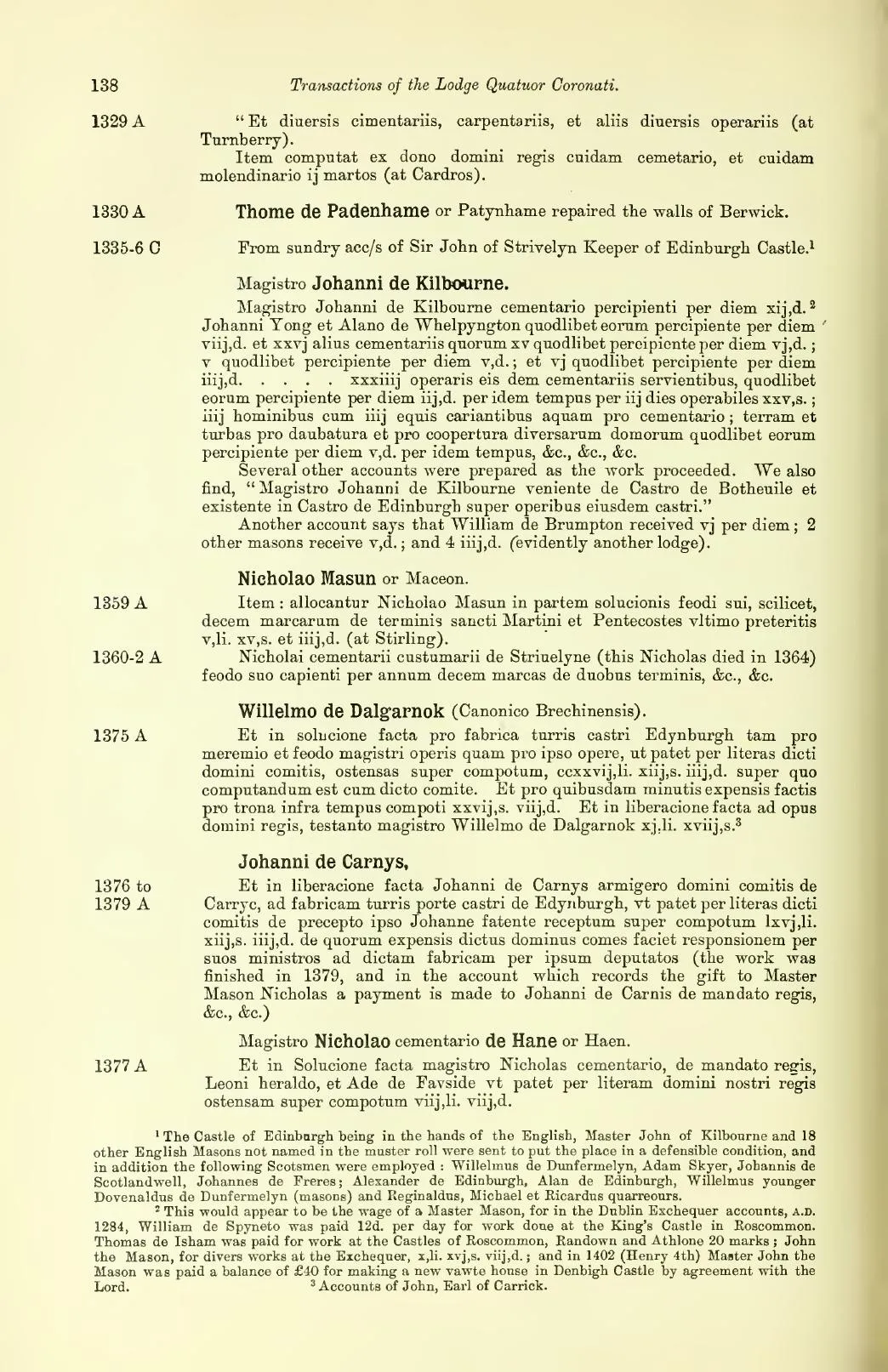
| Date | Content | |
|---|---|---|
| 1329 A | "Et diversis cimentariis, carpentariis, et aliis diversis operariis (at Turnberry). | |
| 1330 A | Thome de Padenhame or Patynhame repaired the walls of Berwick. | |
| 1335-6 C | From sundry acc/s of Sir John of Strivelyn Keeper of Edinburgh Castle.¹ | |
| Magistro Johanni de Kilbourne. | ||
| Magistro Johanni de Kilbourne cementario percipienti per diem xij,d.² | ||
| Johanni Yong et Alano de Whelpyngton et quodlibet eorum percipiente per diem vj,d.; et xxv alius cementariis quorum xv quodlibet percipiente per diem vj,d.; v quodlibet percipiente per diem v,d.; et vj quodlibet percipiente per diem iiij,d. . . . xxxiiij operariis eis dem cementariis servientibus, quodlibet eorum percipiente per diem iij,d. per idem tempus per iij dies operabiles xxv,s.; iiij hominibus cum iiij equis cariantibus aquam pro cementario; terram et turbas pro daubatura et pro coopertura diversarum domorum quodlibet eorum percipiente per diem v,d. per idem tempus, &c., &c. | ||
| Several other accounts were prepared as the work proceeded. We also find, "Magistro Johanni de Kilbourne veniente de Castro de Botheuile et existente in Castro de Edynburgh super operibus eiusdem castri." | ||
| Another account says that William de Brumpton received vj per diem; 2 other masons receive v,d.; and 4 iiij,d. (evidently another lodge). | ||
| Nicholao Masun or Maceon. | ||
| 1359 A | Item: allocantur Nicholao Masun in partem solucionis feodi sui, scilicet, decem marcarum de terminis sancti Martini et Pentecostes vltimo preteritis v,li. xv,s. et iiij,d. (at Stirling). | |
| 1360-2 A | Nicholai cementarii custumarii de Strinelyne (this Nicholas died in 1364) feodo suo capienti per annum decem marcas de duobus terminis, &c., &c. | |
| Willelmo de Dalgarnok (Canonico Brechinensis). | ||
| 1375 A | Et in solucione facta pro fabrica turris castri Edynburgh tam pro meremio et feodo magistri operis quam pro ipso opere, ut patet per literas dicti domini comitis, ostensas super computum, ccxxvij,li. xiij,s. iiij,d. super quo computandum est cum dicto comite. Et pro quibusdam minutis expensis factis et pro trona infra tempus compoti xxvij,s. viij,d. Et in liberacione facta ad opus domini regis, testanto magistro Willelmo de Dalgarnok xj,li. xviij,s.³ | |
| Johannis de Carnys, | ||
| 1376 to | Et in liberacione facta Johanni de Carnys armigero domini comitis de | |
| 1379 A | Carryc, ad fabricam turris porte castri de Edynburgh, vt patet per literas dicti comitis de precepto ipso Johanne fatente receptum super computum lxvj,li. xiij,s. iiij,d. de quorum expensis dictus dominus comes faciet responsionem per suos ministros ad dictam fabricam per ipsum deputatos (the work was finished in 1379, and in the account which records the gift to Master Mason Nicholas is a payment made to Johanni de Carnis de mandato regis, &c., &c.) | |
| 1377 A | Magistro Nicholao cementario de Hane or Haen. | |
| Et in Solucione facta magistro Nicholas cementario, de mandato dicti Leoni heraldo, et Ade de Favside vt patet per literam domini nostri regis ostensam super computum viij,li. viij,d. |
¹ The Castle of Edinburgh being in the hands of the English, Master John of Kilbourne and 18 other English Masons not named in the muster roll were sent to put the place in a defensible condition, and in addition the following Scotsmen were employed: Willelmus de Dunfermelyn, Adam Skyer, Johannis de Scotlandwell, Johannes de Preses; Alexander de Edinburgh, Alan de Edinburgh; Willelmus younger Dovenaldus de Dunfermelyn (mason) and Reginaldus, Michael et Ricardus quarreours. ² This would appear to be the wage of a Master Mason, for in the Dublin Exchequer accounts, A.D. 1284, William de Spyneto was paid 12d. per day for work done at the King's Castle in Roscommon. Thomas de Isham was paid for work at the Castles of Roscommon, Randown and Athlone 20 marks; John the Mason, for divers works at the Exchequer, x,li. xvj,s. viij,d.; and in 1402 (Henry 4th) Master John the Mason was paid a balance of £40 for making a new vawte house in Denbigh Castle by agreement with the Lord. ³ Accounts of John, Earl of Carrick.
[Page 195] — Transactions of the Lodge Quatuor Coronati. — 139
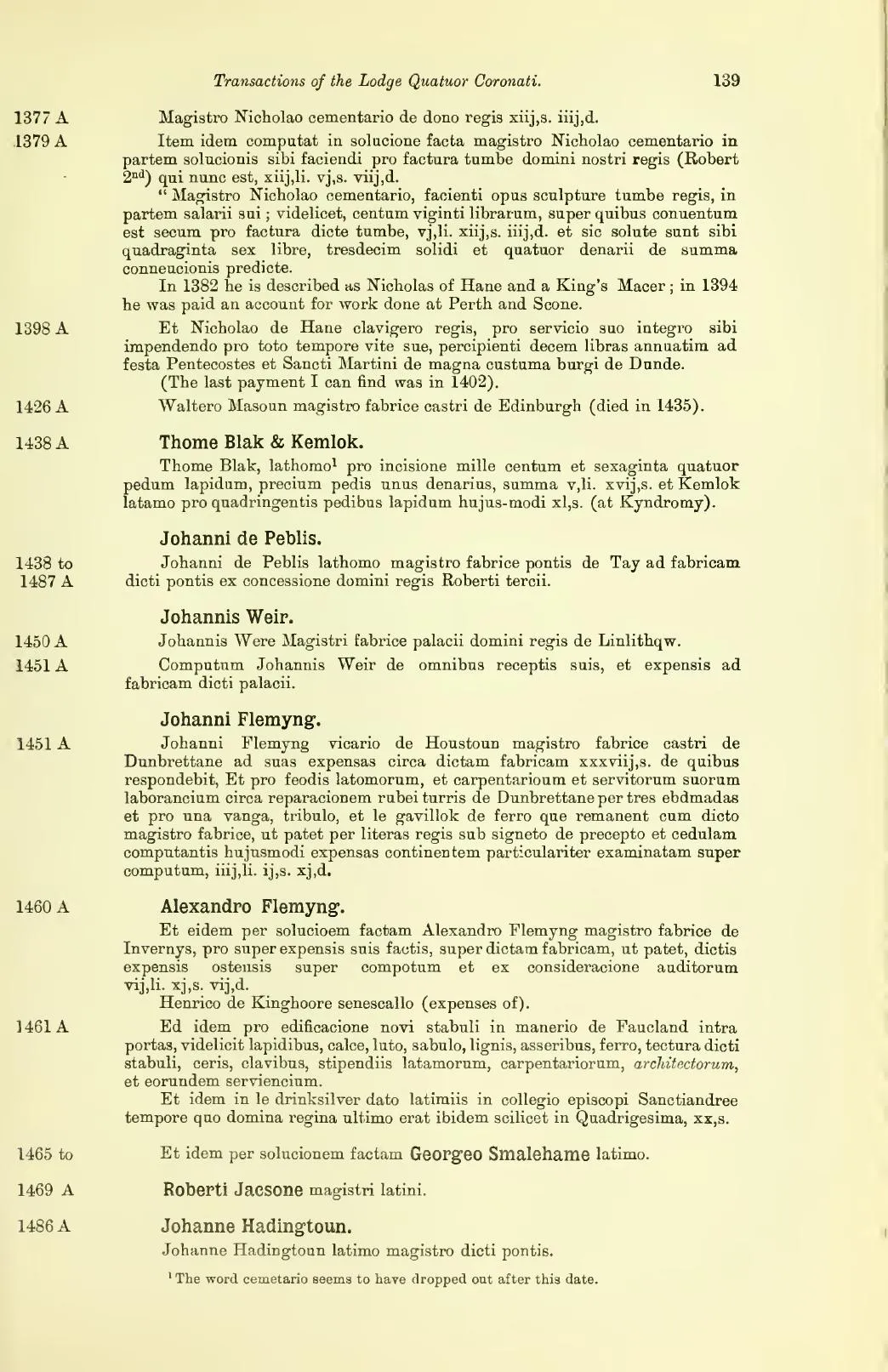
| Date | Content | |
|---|---|---|
| 1377 A | Magistro Nicholao cementario de dono regis xiij,s. iiij,d. | |
| 1379 A | Item idem computat in solucione facta magistro Nicholao cementario in partem solucionis sibi faciendi pro factura tumbe domini nostri regis (Robert 2nd) qui nunc est, xiij,li. vj,s. viij,d. | |
| "Magistro Nicholao cementario, facienti opus sculpture tumbe regis, in partem salarii sui; videlicet, centum viginti librarum, super quibus conuentum est secum pro factura dicte tumbe, vj,li. xiij,s. iiij,d. et sic solute sunt sibi quadraginta sex libre, tresdecim solidi et quatuor denarii de summa connexionis predicte. | ||
| In 1382 he is described as Nicholas of Hane and a King's Macer; in 1394 he was paid an account for work done at Perth and Scone. | ||
| 1398 A | Et Nicholao de Hane clavigero regis, pro servicio suo integro sibi impendendo pro toto tempore vite sue, percipienti decem libras annuatim ad festa Pentecostes et Sancti Martini de magna custuma burgi de Dunde. | |
| (The last payment I can find was in 1402.) | ||
| 1426 A | Waltero Masoun magistro fabrice castri de Edinburgh (died in 1435). | |
| 1438 A | Thome Blak & Kemlok. | |
| Thome Blak, lathomo¹ pro incisione mille centum et sexaginta quatuor pedum lapidum, precium pedis unus denarius, summa v,li. xvij,s. et Kemlok latomo pro quadringentis pedibus lapidum hujus-modi xl,s. (at Kyndromy). | ||
| Johanni de Peblis. | ||
| 1438 to | Johanni de Peblis lathomo magistro fabrice pontis de Tay ad fabricam | |
| 1487 A | dicti pontis ex concessione domini regis Roberti tercii. | |
| Johannis Weir. | ||
| 1450 A | Johannis Were Magistri fabrice palacii domini regis de Linlithqw. | |
| 1451 A | Computum Johannis Weir de omnibus receptis suis, et expensis ad fabricam dicti palacii. | |
| Johanni Flemyng. | ||
| 1451 A | Johanni Flemyng vicario de Houstoun magistro fabrice castri de Dunbrettane ad suas expensas circa dictam fabricam xxxviij,s. de quibus respondebit, Et pro feodis latomorum, et carpentarioum et servitorum suorum laborancium circa reparacionem rubei turris de Dunbrettane per tres ebdmadas et pro una vanga, tribulo, et le gavillok de ferro que remanent cum dicto magistro fabrice, ut patet per literas regis sub signeto de precepto et cedulam magistro fabrice hujusmodi expensas contententem particulariter examinatam super computum, iiij,li. ij,s. xj,d. | |
| 1460 A | Alexandro Flemyng. | |
| Et eidem per solucionem factam Alexandro Flemyng magistro fabrice de Invernys, pro super expensis suis factis, super dictam fabricam, ut patet, dictis expensis ostensis super computum et ex consideracione auditorum viij,li. xj,s. viij,d. | ||
| Henrico de Kinghoore senescallo (expenses of). | ||
| 1461 A | Ed idem pro edificacione novi stabuli in manerio de Faucland intra portas, videlicit lapidibus, calce, luto, sabulo, lignis, asseribus, ferro, tectura dicti stabuli, ceris, clavibus, stipendiis latomorum, carpentariorum, architectorum, et eorundem serviencium. | |
| Et idem in le drinksilver dato latimiis in collegio episcopi Sanctiandree tempore quo domina regina ultimo erat ibidem scilicet in Quadrigesima, xx,s. | ||
| 1465 to | Et idem per solucionem factam Georgeo Smalehame latimo. | |
| 1469 A | Roberti Jacsone magistri latini. | |
| 1486 A | Johanne Hadingtoun. | |
| Johanne Hadingtoun latimo magistro dicti pontis. |
¹ The word cemetario seems to have dropped out after this date.