William Blake
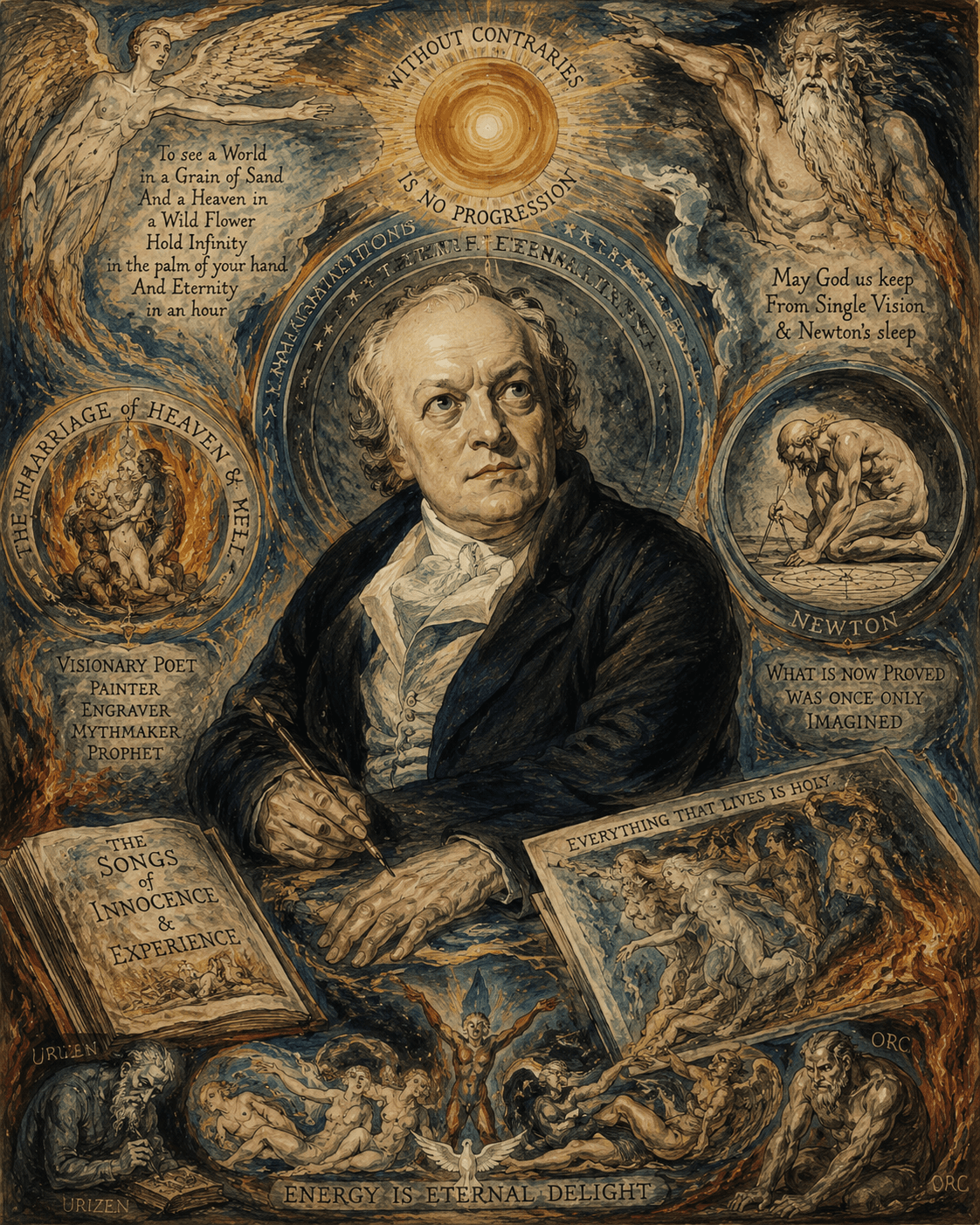
Poet. Artist. Mystic. Critic of reductionism itself. William Blake represents almost the inverse of the modern mechanistic worldview. Where John Dee stands at the threshold before the Scientific Revolution fully crystallized, Blake stands inside the Industrial Revolution actively resisting its metaphysics.
Blake believed that imagination was not fantasy, symbolism was not decoration, and myth was not primitive error. Instead, imagination was a mode of perception — a way of apprehending dimensions of reality flattened by reductionism. He saw mechanistic rationality as spiritually dangerous when elevated above all other forms of knowing.
Living amid the rise of industrial modernity, Blake saw a civilization increasingly entranced by measurement, categorization, and mechanistic certainty. Against this, he defended imagination as essential to human wholeness. Every age develops a symbolic language it mistakes for reality itself; Blake's warning was not against science, but against "single vision" — the collapse of reality into only that which can be quantified.
Blake's famous image of Newton — bent over geometric diagrams, absorbed in abstraction while ignoring the living cosmos around him — captures the anxiety at the heart of modernity: that a civilization capable of measuring the cosmos may simultaneously lose the ability to see it. He famously wrote: "May God us keep / From Single Vision & Newton's sleep."
Yet Blake was not merely anti-system. His prophetic works constructed entire symbolic architectures populated by recurring archetypes — Urizen representing law and rational abstraction, Los embodying imagination and prophetic vision, Orc symbolizing revolution and dynamic energy. He built a competing metaphysics: mythic, recursive, visionary, psychologically charged.
Blake becomes surprisingly modern in an age of AI debates, algorithmic culture, and metrics-driven institutions. He warned that systems optimized only for rational efficiency eventually deform human perception. The structure of his critique maps onto contemporary concerns about machine mediation of meaning, optimization without understanding, and the loss of symbolic depth in institutional life.
Every age mistakes its symbolic operating system for reality itself. Blake simply named what his own age was forgetting: that quantification and mechanization, taken as the complete picture, become a form of spiritual blindness.