Sima Qian
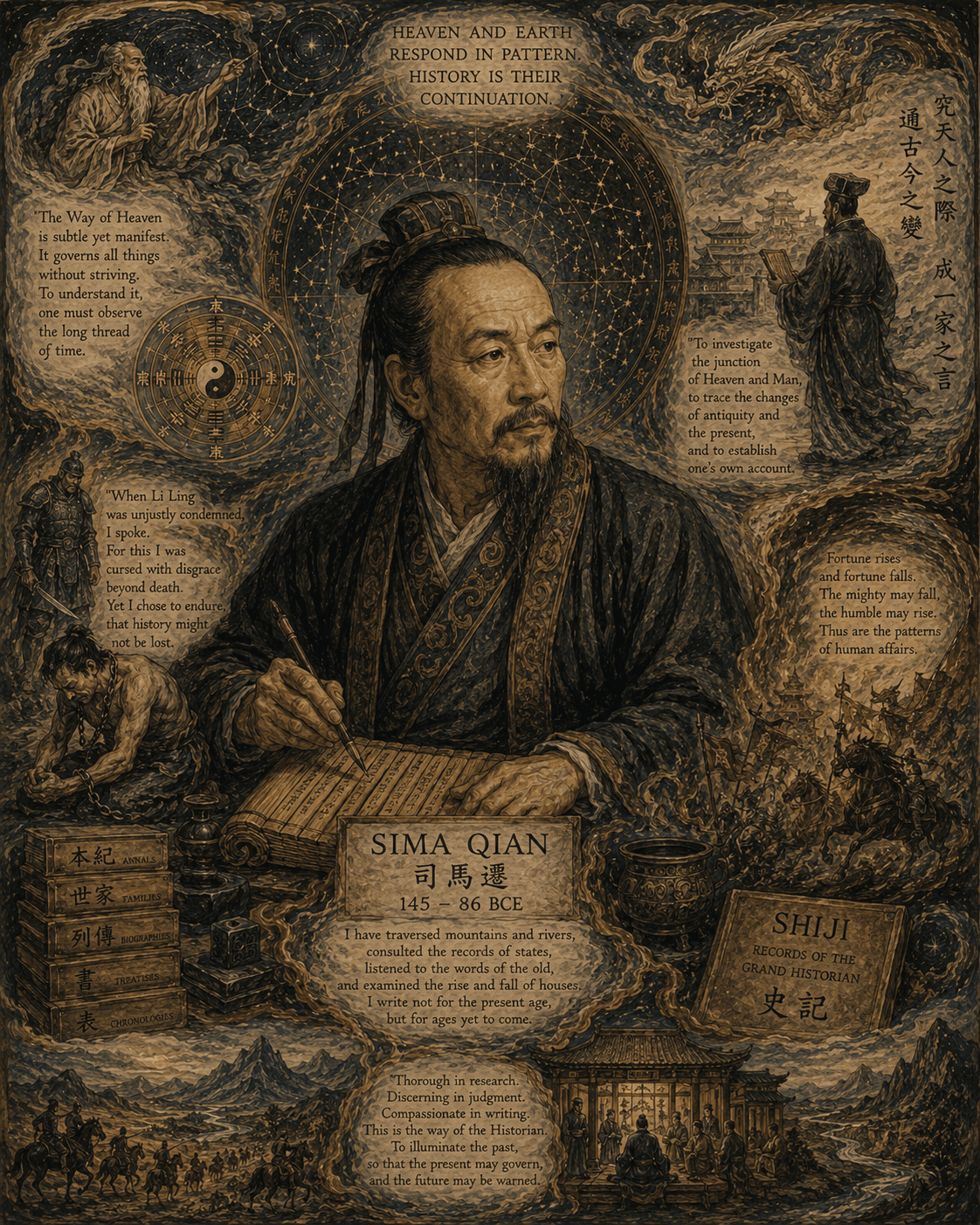
Sima Qian stands at the foundation of Chinese historical consciousness. More than a historian, he was an architect of civilizational memory — a figure who transformed history from a collection of royal records into a coherent symbolic system linking morality, cosmology, politics, fate, and human character across time.
Living during the Han dynasty, Sima Qian inherited the role of Grand Historian from his father, whose unfinished ambition was to create a comprehensive account of the world from legendary antiquity to their present age. After his father's death, Sima Qian devoted himself to completing this vision, producing the monumental Records of the Grand Historian ( Shiji).
The Shiji became one of the most influential historical works in East Asian civilization. But it was not "history" in the modern mechanistic sense of neutral chronology and detached data collection. For Sima Qian, history was a living structure of patterns.
Kings, rebels, sages, generals, merchants, philosophers, assassins, wanderers, and dynasties all participated in larger cycles shaped by virtue, ambition, timing, Heaven's mandate, and the unpredictable transformations of fortune. Events were never merely isolated facts. They formed constellations of meaning across generations.
Sima Qian wrote at a time when Chinese civilization still understood history, cosmology, astronomy, ritual, governance, and morality as deeply interconnected domains. The historian was not merely an archivist, but an interpreter of patterns between Heaven and human affairs. His worldview emerged from a civilization shaped by correlative cosmology, dynastic cycles, omen interpretation, calendrical systems, Confucian ethics, Legalist statecraft, Daoist concepts of transformation, and the symbolic structures surrounding the I Ching.
In this world, timing mattered. Alignment mattered. Moral failure could destabilize not only governments, but the harmony between Heaven and Earth themselves.
Yet Sima Qian's life also revealed the brutal realities of political power. After defending the disgraced general Li Ling before Emperor Wu of Han, Sima Qian was condemned to castration and imprisonment — a humiliation many officials considered worse than death. Rather than commit suicide to preserve honor, he chose to endure disgrace in order to complete the Shiji, believing his work would outlive both personal suffering and imperial politics.
This decision transformed him into something more than a court historian. It made him a witness to the tension between truth and power. The Shiji does not simply praise emperors or record events. It repeatedly examines the instability of fortune: how the powerful fall, how obscure figures reshape history, how virtue and success diverge, how systems decay from within, and how human beings attempt to impose order on an unpredictable world.
Modern historical writing often aspires toward objectivity through detachment. Sima Qian pursued something different: moral and cosmological intelligibility. His histories sought not merely to record events, but to reveal the deeper patterns binding character, timing, fate, and civilization together.
In this sense, Sima Qian belongs to the same larger lineage as figures like John Dee, Newton, Blake, and Jung — thinkers operating within symbolic systems larger than the categories later imposed by modern disciplinary boundaries. But unlike Dee's Hermeticism or Jung's psychology, Sima Qian's symbolic world was fundamentally historical. For him, history itself was the great symbolic system: a recursive structure through which civilizations remembered, justified, warned, legitimized, and understood themselves.
Every civilization develops narratives explaining why power rises and falls. Sima Qian recognized that beneath political events lay recurring human patterns — ambition, virtue, betrayal, timing, loyalty, hubris, transformation — repeating across centuries under different names. His work remains one of humanity's earliest and greatest attempts to transform memory into a system capable of perceiving civilization across time.