John Dee
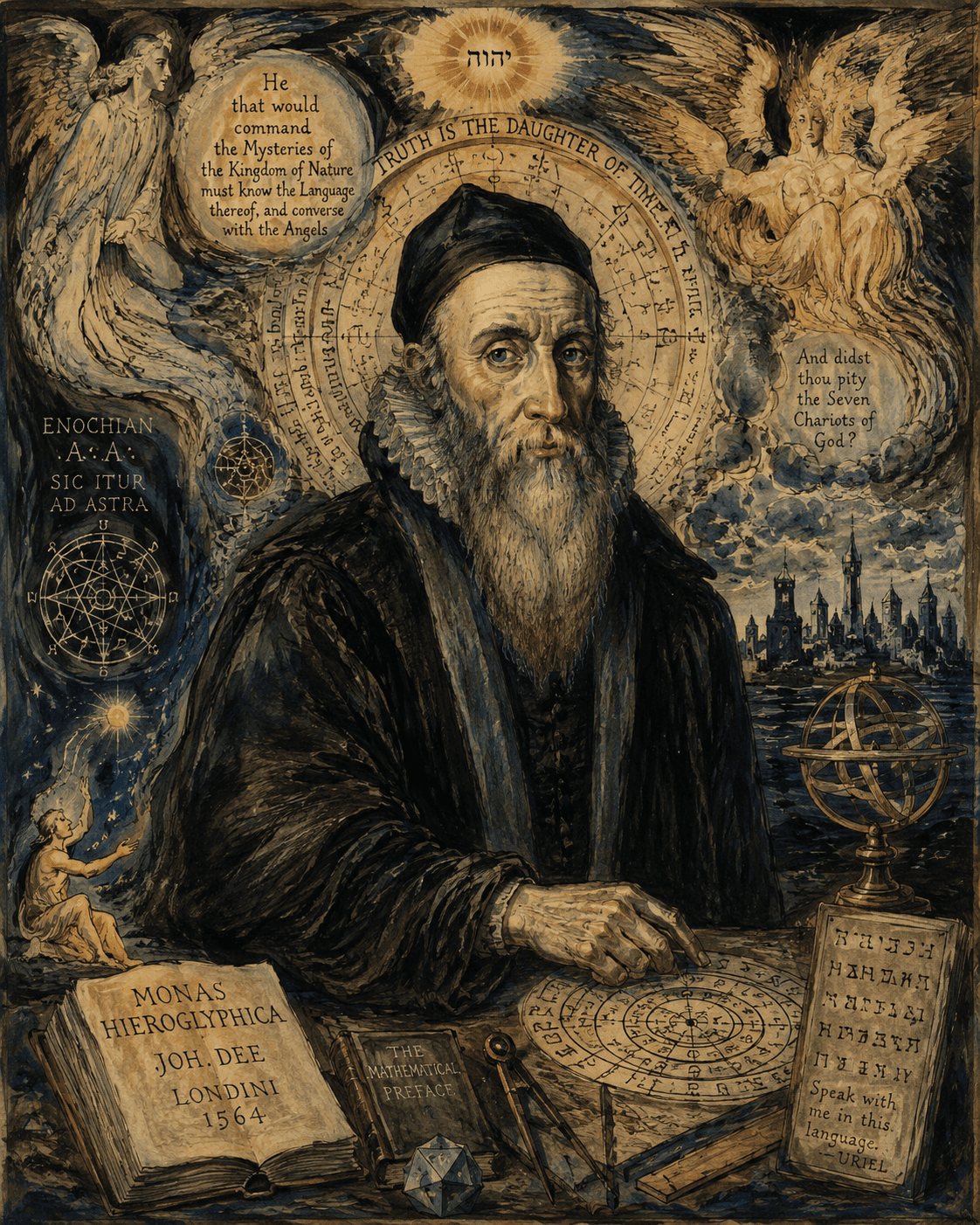
Mathematics. Navigation. Empire. Cryptography. Astrology. Angelology. Sacred geometry. John Dee held these together and did not experience them as contradictory.
He was one of the last great unified-knowledge polymaths before knowledge fragmented into modern disciplines — a symbolic hinge between Renaissance Hermeticism and the mechanistic science that would follow.
What modern culture forgets is that the transition from "superstition" to "rationality" was never clean. Figures like Dee, Newton, Kepler, and Boyle did not simply choose between alchemy and astronomy. They worked within worlds where reality was assumed to possess hidden structure, symbolic coherence, mathematical intelligibility, and correspondences across scales.
The categories themselves are historically contingent. "Science defeated superstition" is a comforting myth that obscures the messier truth: what changed was not simply that people became rational, but that the definition of legitimate knowledge narrowed.
Dee forces us to confront this. He was unquestionably brilliant — a mathematician and adviser to Elizabeth I, a major advocate for navigation and English imperial ambition, and a figure associated with cryptography and intelligence — yet he also spent years attempting to communicate with angels through elaborate symbolic systems.
The point is not that Dee was "secretly right" about angels. The point is that every system of knowledge projects authority by naming what it knows, while often concealing the boundaries of what it cannot know. Mechanistic certainty creates the illusion of completeness.
Every age mistakes its own symbolic system for reality itself. Dee simply operated in an age whose symbolic system was more explicitly mystical. The blind spots are different; the structure is the same.