Isaac Newton
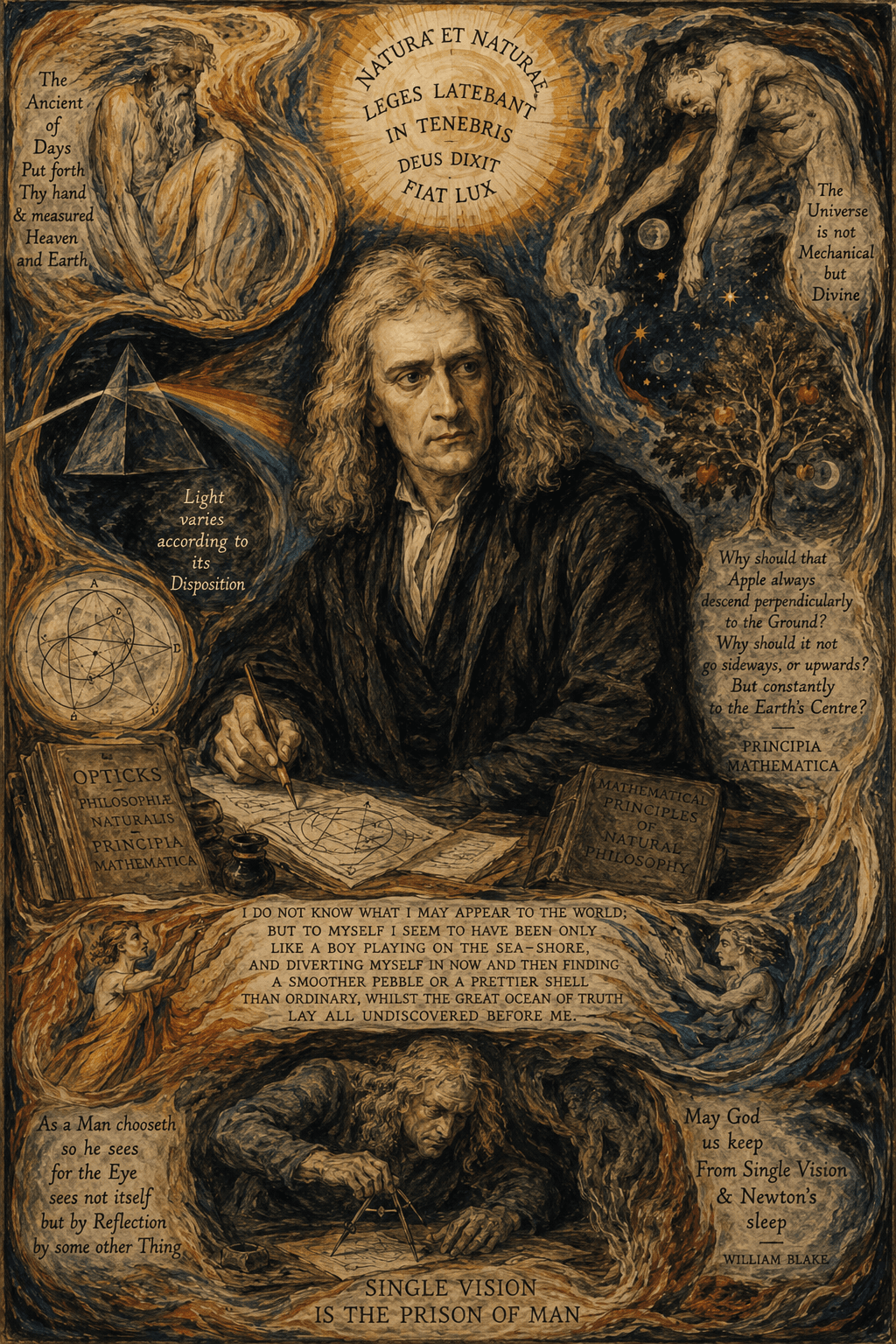
Isaac Newton is remembered as the architect of the mechanistic universe: the mathematician who described gravity, formulated the laws of motion, pioneered calculus, and helped establish the foundations of modern physics. In the modern imagination, he stands as the great symbol of rational science — the figure who transformed the cosmos from mystery into mathematics.
Yet this image is incomplete. What history often forgets is that Newton did not perceive a contradiction between physics and alchemy, between mathematical law and hidden correspondences. Alongside his work in optics and mechanics, he devoted immense effort to alchemical experimentation, Biblical chronology, theology, and the search for deeper structures underlying visible reality. He wrote extensively on subjects modern culture would classify as "occult," and in private may have spent as much intellectual energy on alchemy and scripture as on physics itself.
Newton emerged from a world still shaped by Renaissance Hermeticism, where the universe was assumed to possess both mathematical intelligibility and symbolic depth. The Scientific Revolution did not begin as a clean rejection of mysticism. Rather, it evolved from within older traditions that sought unity between matter, spirit, number, and cosmic order.
This is what makes Newton historically unsettling. He helped create the mechanistic worldview that would dominate modernity, yet he himself never fully inhabited it. Modern culture remembers Newton as the man who explained gravity, but Newton also believed reality concealed hidden principles not yet understood — subtle forces, transformations, and structures that could not be reduced to surface appearances alone. His alchemical pursuits were not irrational distractions from science; to Newton, they were part of the same search for the hidden architecture of creation.
In this sense, Newton stands not simply as the founder of modern science, but as a transitional figure between symbolic and mechanistic civilizations. He represents the moment when unified systems of knowledge began fragmenting into separate disciplines: physics separated from metaphysics, chemistry from alchemy, astronomy from astrology, science from theology.
The modern myth says that rationality defeated superstition. Newton's life suggests something more complicated. The boundaries between legitimate and illegitimate knowledge were still fluid, and many of the people who built modern science did so while standing with one foot in older symbolic worlds.
Newton forces us to confront an uncomfortable possibility: that every age mistakes its own model of reality for completeness. His equations transformed humanity's understanding of the cosmos, yet he himself remained aware that vast territories of the unknown still lay beyond measurement.
As he famously reflected near the end of his life:
"I do not know what I may appear to the world, but to myself I seem to have been only like a boy playing on the sea-shore... whilst the great ocean of truth lay all undiscovered before me."