Carl Jung
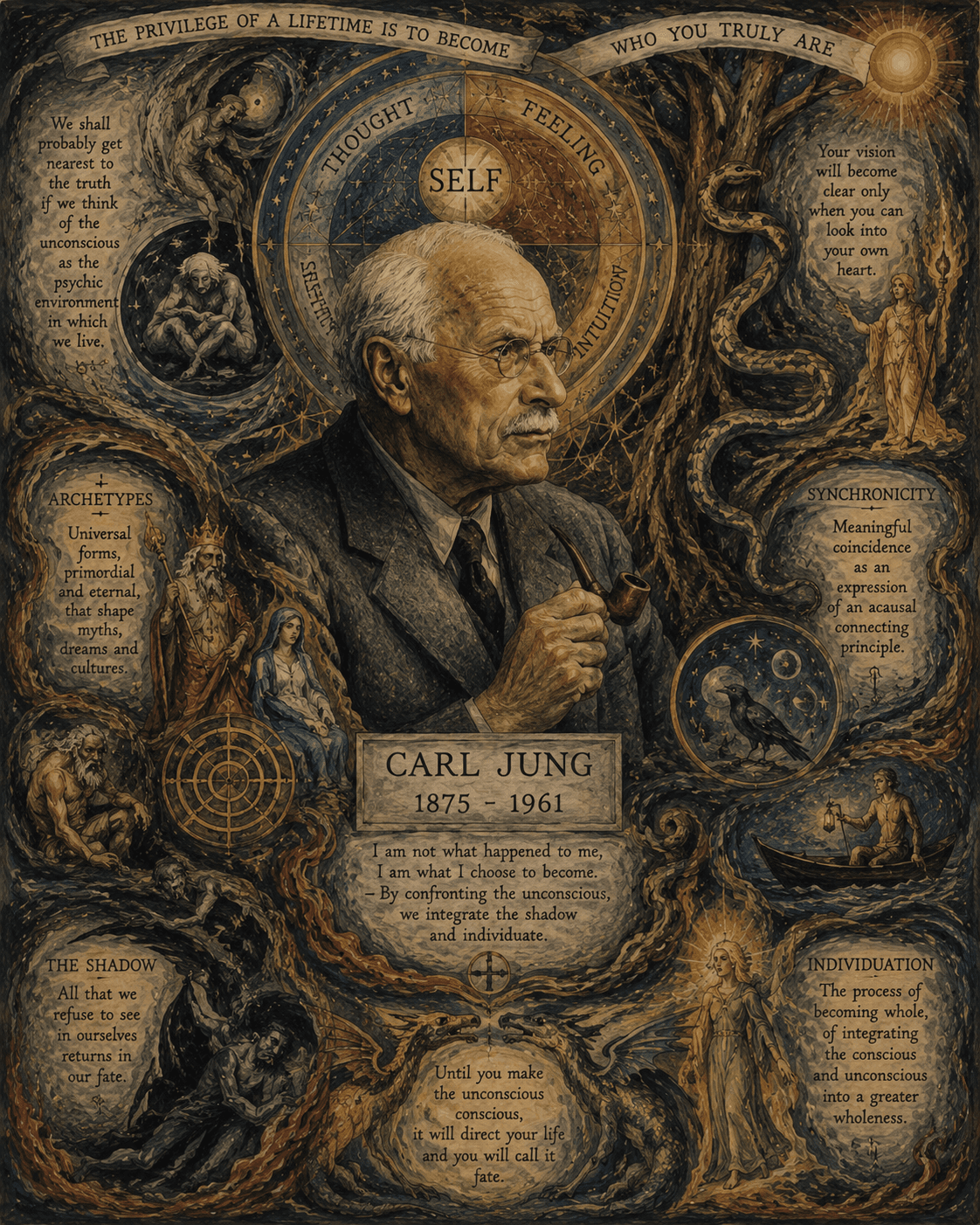
Carl Jung occupies a unique position in the history of modern thought: neither scientist nor mystic in the traditional sense, but a bridge figure who attempted to restore symbolic meaning to a civilization increasingly dominated by mechanistic psychology and materialism.
Where John Dee stood before the Scientific Revolution, and Newton helped usher it into dominance, Jung emerged centuries later amid its psychological consequences. By Jung's time, the modern world had become highly effective at measuring external reality while growing increasingly uncertain about the inner world of meaning, myth, symbolism, and spirit. Human beings could explain the mechanics of matter, yet struggled to explain dreams, religious experience, archetypes, synchronicity, or the recurring symbolic patterns that appeared across civilizations and eras.
Jung believed these patterns mattered. Trained as a psychiatrist and initially associated with Sigmund Freud, Jung eventually broke from Freud's reductionist emphasis on sexuality and pathology. He became convinced that the human psyche possessed deeper structures — inherited symbolic architectures that shaped perception, behavior, myth, religion, and culture itself. He called these structures archetypes.
To Jung, myths, alchemy, astrology, religious visions, mandalas, dreams, and ancient symbolic systems were not primitive superstitions to be discarded, but expressions of recurring psychological patterns embedded within human consciousness. This did not mean Jung believed every mystical claim literally. Rather, he believed modern rationality had become dangerously one-sided — capable of analyzing symbols without understanding why humans continually generate them.
Jung's work repeatedly returned to traditions dismissed by modernity: alchemy, Gnosticism, astrology, Hermetic symbolism, the I Ching, comparative mythology, dream interpretation — not because he rejected science, but because he believed the psyche could not be fully understood through mechanistic explanation alone.
One of Jung's most influential ideas was synchronicity. He proposed that meaningful coincidences might reveal patterns of symbolic alignment not reducible to simple causality. This idea deeply fascinated him because it suggested reality may contain forms of connection modern scientific frameworks struggle to describe.
For Jung, symbolic systems were not merely irrational leftovers from humanity's past. They were maps of psychological experience accumulated across centuries. This is what makes Jung so historically significant: he stands at the point where modern intellectual culture began rediscovering symbolic thinking after centuries of aggressive rational reduction.
But unlike many occult revivalists, Jung attempted to engage symbolism without fully abandoning scientific discipline. He approached mythology, alchemy, religion, and dreams as structured expressions of the human psyche rather than supernatural curiosities. In this sense, Jung represents a partial return of the symbolic world that figures like Newton and Dee once inhabited — translated into the language of modern psychology.
Yet Jung also serves as a warning. He recognized that civilizations which suppress symbolic meaning too completely often experience its return in distorted forms: fanaticism, mass movements, projection, ideological possession, and collective irrationality. The symbolic layer of human existence does not disappear simply because a culture declares itself rational.
Modern society often treats symbolic systems as obsolete because they cannot be cleanly quantified. Jung argued the opposite: that symbolic thinking remains fundamental to how humans construct identity, meaning, morality, and reality itself. Every age develops a model of the mind it mistakes for completeness. Jung's work suggests the psyche is always larger than the frameworks used to describe it.